本文由 AI(DeepSeek-Flash) 检索、整理并撰写,尚未经过人工逐条校对。文中的文献信息经过初步核对(部分附 DOI),但作者、年份、卷期仍可能存在错误;引用前请以 DOI 或出版方页面为准。
This article was retrieved, organised, and written by AI (DeepSeek-Flash) and has not yet been verified item by item by a human. The bibliographic information has been checked only preliminarily (some entries include a DOI), but authors, years, volumes, and issue numbers may still contain errors; before citing, please rely on the DOI or the publisher’s page.
文中所有图都是概念示意图,由本文 R 代码在渲染时生成,不是实验数据。凡属作者推论、类比或尚未被实验支持的主张,正文中都会用”推测”“假说”“目前的模型认为”等措辞显式标注;请把这类句子与有实验依据的陈述区分开。
All figures in this article are conceptual schematics generated at render time by the article’s own R code; they are not experimental data. Wherever a claim is an inference or analogy by the author, or is not yet supported by experiment, the text explicitly flags it with wording such as “speculation”, “hypothesis”, or “current models suggest”; please distinguish such sentences from statements that have experimental support.
This article does not claim that the problem of the origin of life has been solved. Its aim is precisely the opposite: to make clear which transitions are already supported by experiment or by models, and which remain blank.
A block of granite, the flame of a candle, a cup of Belousov–Zhabotinsky reaction liquid oscillating periodically between yellow and blue, and a dividing Escherichia coli cell—place these four things side by side on a table and almost anyone will immediately point to “the last one is alive.” Yet when pressed on what the basis for that judgement is, the answer at once becomes vague: bacteria metabolise, but a flame also consumes fuel; bacteria replicate, but the reaction liquid can also replicate a pattern in time; bacteria have a boundary, but so does a rock; bacteria respond to their environment, but a flame also changes shape with the airflow.
The difficulty of origin-of-life research is not merely that “we do not yet know the chemical reaction pathway.” A deeper layer is this: the very standard by which we judge “this is life” is itself a philosophically unclarified mixture—partly a thermodynamic intuition (it sustains itself far from equilibrium), partly an informational intuition (it transmits information to the next generation), partly a teleological intuition (it serves some purpose), and partly nothing more than contingent features of terrestrial biology (it has a cell membrane, uses DNA, contains carbon).
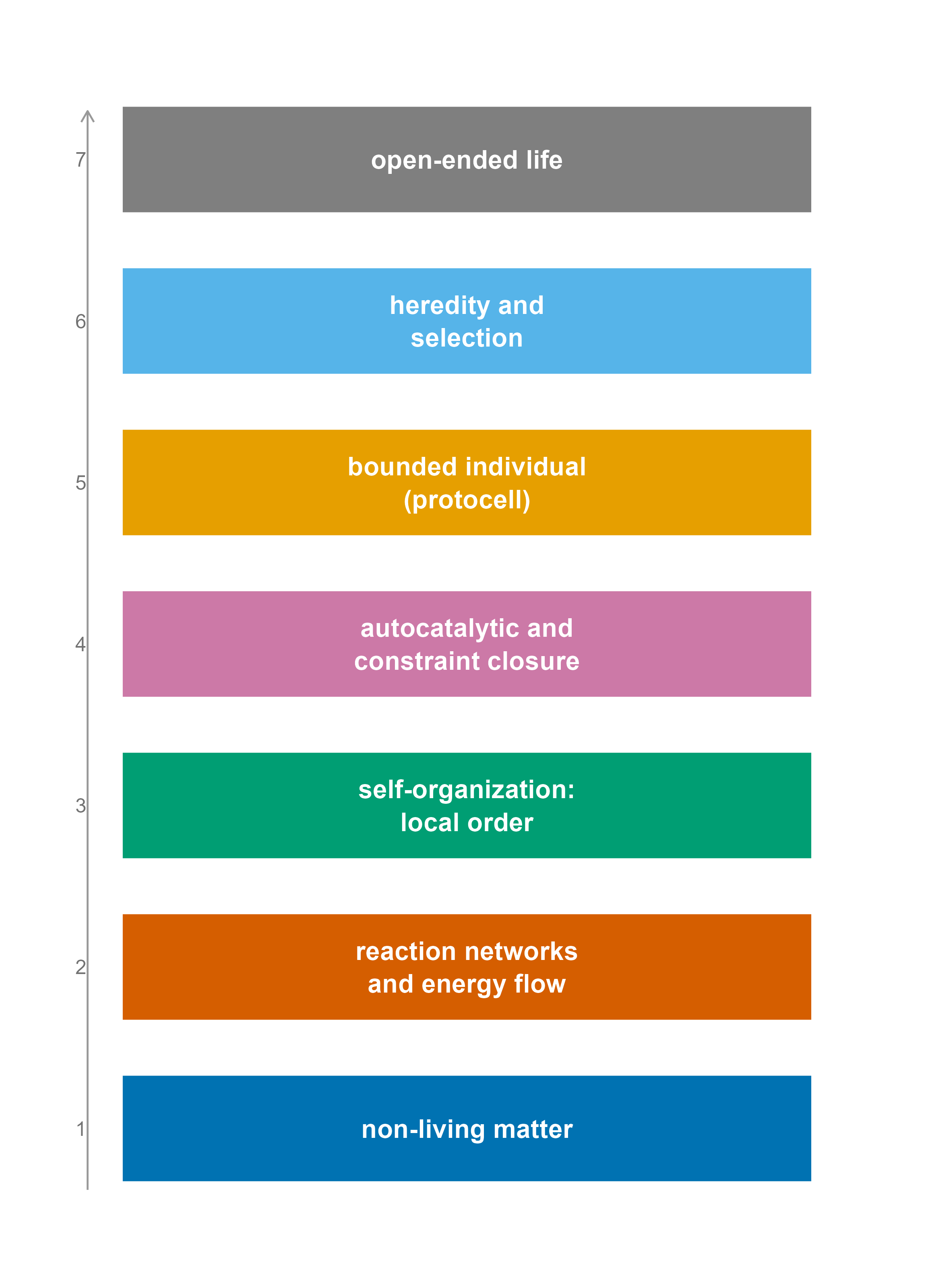
This article is therefore not organised by discipline (philosophy, chemistry, thermodynamics, computer science) but advances along a single conceptual thread: through which transformations of organisation must a piece of matter pass before it deserves to be called “alive”? This thread can be drawn as a rough roadmap:
Figure 1: 从物质到生命的概念路线图。每一级台阶都对应一种组织方式的改变,而不是某种新物质的出现。这个顺序是分析性的,不代表历史上必然按此顺序发生;真实过程可能重叠、并行、甚至跳跃。 | A conceptual roadmap from matter to life. Each step corresponds to a change in the mode of organisation, not to the appearance of a new kind of substance. This ordering is analytical; it does not imply that the historical process necessarily followed it, and the real process may have overlapped, run in parallel, or even jumped.
需要预先说明三种”证据等级”,因为后文会反复用到:
Three “grades of evidence” must be stated in advance, because they will recur repeatedly in what follows:
实验事实:在受控条件下重复观察到,例如某条反应路径在模拟早期地球条件下能生成核苷酸。
Experimental fact: repeatedly observed under controlled conditions—for example, that a given reaction pathway can produce nucleotides under conditions simulating the early Earth.
Model result: holds under explicit mathematical assumptions—for example, the threshold at which a giant connected component appears in a random catalytic network; change the assumptions and the conclusion may change.
Philosophical interpretation: a conceptual framework used to organise facts—for example, “life is a process rather than a substance.” It cannot be refuted by experiment alone, but it can influence which experiments we design.
Conflating these three is the most common error in discussions of the origin of life—and the most reliable way to produce headlines of the form “scientists have cracked the origin of life.”
第一章 生命为什么是一个哲学难题? / Chapter 1. Why Is Life a Philosophical Problem?
1.1 四种”像生命”的东西 / 1.1 Four Things That Look Like Life
先做一次思想实验。把岩石、火焰、化学振荡反应和细菌放在同一张桌子上,逐一检查它们共享哪些属性:
Begin with a thought experiment. Place a rock, a flame, a chemical oscillating reaction, and a bacterium on the same table, and examine one by one which properties they share:
A flame satisfies “far from equilibrium + self-maintenance” almost completely, yet it does not satisfy “heritable variation.” The BZ reaction satisfies both “self-organisation + temporal periodicity,” yet it has no transmission of information. A bacterium possesses all of them at once, and these properties are coupled to one another: the membrane maintains a concentration gradient, the gradient drives metabolism, and the products of metabolism participate in the synthesis of membrane lipids.
The point of this table is not to find a dividing line but to notice that “being alive” is not a binary property but a set of mutually dependent capacities. This leads directly to the three typical strategies in modern definitions of life.
1.2 亚里士多德:形式、潜能与现实 / 1.2 Aristotle: Form, Potentiality, and Actuality
In De Anima, Aristotle offers a definition that remains one of the most fertile philosophical frameworks available: a living thing is a natural body that possesses a soul (psychē), and the soul is “the form (eidos) of a natural body that potentially has life.” “Form” here does not mean outward shape but the organising principle that makes matter into “this kind of thing.”
More decisively, he distinguishes potentiality (dynamis) from actuality (energeia). A seed is potentially a tree; an eye is potentially able to see. Life is not some mysterious ingredient added to matter; it is the way matter, under a particular organisation, continuously realises its own functions.
The modern echoes of this framework are unmistakable: as we shall see, the autopoietic claim that “the system continuously produces its own components,” and Kauffman’s Kantian whole, in which “the whole exists for the parts and the parts for the whole,” are at bottom reinterpretations of “form” as the causal closure of organisation. Aristotle’s underlying question—whether life is a substance or a process—has never really gone away.
1.3 机械论与活力论:一场没有真正结束的争论 / 1.3 Mechanism and Vitalism: An Argument That Never Really Ended
From the seventeenth century onward, mechanism likened organisms to clocks: the heart is a pump, the lungs are bellows, the muscles are levers. Descartes even held that animals are automata. Vitalism, by contrast, maintained that life contains some non-physical “vital force” (the forerunner of the élan vital) that cannot be explained by physics and chemistry.
Twentieth-century molecular biology effectively pronounced a death sentence on vitalism: no “vital force” violating the laws of physics was ever found. Yet the debate left behind a problem that has not really been resolved: does reducing life entirely to interactions among molecules discard some genuine causal structure?
The compromise offered by contemporary “new mechanism” and systems biology is this: introduce no mysterious forces, but acknowledge that levels of organisation themselves possess causal efficacy. The properties of an enzyme are determined by its molecular structure, but questions such as “in which compartment does this reaction occur, and which regulatory network controls it” cannot be answered at the level of atoms alone.
1.4 康德:部分与整体的相互依赖 / 1.4 Kant: The Mutual Dependence of Parts and Whole
In §65 of the Critique of Judgement (1790), Kant gives a frequently cited formulation: in an organised product of nature, every part is at once means and end; a part can exist only in relation to the whole, and the whole exists through the parts.
He calls such an object a “natural end” (Naturzweck) and stresses that this is a regulative principle of reflective judgement, not constitutive knowledge. In other words: in looking at organisms we cannot avoid teleological language, but that does not prove that nature actually has purposes.
康德的表述之所以重要,是因为它预见了现代”因果闭合”的思想:生命系统的特殊性不在于它由什么组成,而在于它的因果关系是循环的——产物反过来是原因。Kauffman 与 Roli 在 2025 年明确把自催化集合称为”康德式整体”,正是这一思路的当代版本。
Kant’s formulation matters because it anticipates the modern idea of “causal closure”: what is distinctive about living systems is not what they are made of but that their causality is circular—the product is in turn the cause. Kauffman and Roli’s explicit description of autocatalytic sets as “Kantian wholes” in 2025 is precisely a contemporary version of this line of thought.
1.5 柏格森与过程哲学:生命作为持续的创造 / 1.5 Bergson and Process Philosophy: Life as Continuous Creation
In Creative Evolution (1907), Bergson rejects the understanding of life as mechanical assembly, and equally rejects the understanding of it as a striving toward some fixed goal. His “vital impetus” (élan vital) is often misread as mysticism, but its real philosophical point is this: evolution is a continuous creative process that cannot be reduced to a selection among pre-existing possibilities.
Individuation: the individual is not a unit given in advance but something gradually constituted in the course of a process—precisely the central problem raised by Simondon in 1958, to which we shall return in Chapter 7.
1.6 薛定谔的问题:生命靠什么对抗熵增? / 1.6 Schrödinger’s Question: What Does Life Use to Resist the Growth of Entropy?
In 1944, Schrödinger posed in What Is Life? a question that is still being cited: why can living things maintain a high degree of order without being flattened by the second law of thermodynamics?
他的回答是”以负熵为食”(feeding on negative entropy):生命从环境中摄取有序性、向环境排放熵。这个表述在物理上并不严格(后来他自己也承认),但方向是对的——生命不是违反第二定律,而是通过加速环境的熵产生来维持自身的低熵。
His answer was “feeding on negative entropy”: life takes order from the environment and discharges entropy into it. The formulation is not physically rigorous (as he himself later conceded), but the direction is right—life does not violate the second law; it maintains its own low entropy by accelerating the production of entropy in its environment.
这一思路在第三章、第四章会被展开为耗散结构与非平衡热力学。这里先记住薛定谔真正贡献的两点:
This line of thought will be developed in Chapters 3 and 4 as dissipative structures and non-equilibrium thermodynamics. For now, two points that constitute Schrödinger’s real contribution should be kept in mind:
Hereditary information must be stored in some kind of “aperiodic crystal”—a prediction that points directly to DNA;
生命的有序性需要一个物理学的解释,而不是一个活力论的解释。
The orderliness of life requires a physical explanation, not a vitalist one.
1.7 现代生命定义的三条路线 / 1.7 Three Routes in Modern Definitions of Life
当代文献中的生命定义大致可以归为三类,每一类都有明显的代价:
Definitions of life in the contemporary literature fall roughly into three classes, each with conspicuous costs:
路线
代表定义
核心判据
主要困难
代谢主义
生命是自我维持的化学反应网络
代谢、自我生产
病毒、休眠孢子被判为”非生命”
复制主义
生命是能够复制并演化的信息载体
复制、变异、选择
无法处理不育的个体与群体选择
自创生 / 组织主义
生命是持续生产自身边界的组织
组织闭合、自主性
判据抽象,难以操作化
English
Route
Representative definition
Core criterion
Main difficulty
Metabolism-first
Life is a self-maintaining chemical reaction network
Metabolism, self-production
Viruses and dormant spores are classed as “non-life”
Replication-first
Life is an information carrier capable of replication and evolution
Replication, variation, selection
Cannot handle sterile individuals or group selection
Autopoiesis / organisation-first
Life is an organisation that continuously produces its own boundary
Organisational closure, autonomy
The criterion is abstract and hard to operationalise
NASA 的”工作性定义”——生命是能够进行达尔文式演化的自我维持化学系统(a self-sustaining chemical system capable of Darwinian evolution)——本质上是复制主义与代谢主义的拼接。它非常有用,因为它同时要求”自我维持”和”可演化”;但它也有两个众所周知的盲点:
The NASA “working definition”—life is a self-sustaining chemical system capable of Darwinian evolution—is at bottom a splice of replicationism and metabolism. It is extremely useful, because it demands both “self-sustaining” and “evolvable”; but it also has two well-known blind spots:
它把”化学”写进了定义,从而在定义上排除了纯数字生命与可能的非化学生命;
It writes “chemical” into the definition, thereby ruling out purely digital life and possible non-chemical life by definition;
它没有说明”自我维持”需要达到什么程度。
It does not say to what degree “self-sustaining” must be achieved.
1.8 边界对象:病毒、朊粒、人工细胞、数字生命 / 1.8 Boundary Objects: Viruses, Prions, Artificial Cells, Digital Life
四个典型边界案例,足以说明为什么”清单式定义”总是不够:
Four typical boundary cases suffice to show why checklist definitions always fall short:
病毒:有基因组、能演化、有明确的复制—选择循环,但离开宿主没有自身代谢。按 NASA 定义,它处于灰色地带。
Viruses: they have a genome, can evolve, and exhibit a clear replication–selection cycle, but outside a host they have no metabolism of their own. Under the NASA definition they occupy a grey zone.
Prions: only a protein conformation propagates; there is no nucleic acid, yet the entity can be “inherited” and selected (different strains have different phenotypes). This challenges the assumption that hereditary information must be carried by nucleic acids.
Artificial cells: they can encapsulate enzymes, synthesise membrane lipids, grow, and even divide, but most cannot autonomously replicate a genome. They demonstrate that “individual properties of life can be separated out and realised in isolation.”
Digital life: the self-replicating programs in Tierra and Avida mutate, are selected, and evolve parasites; they satisfy “evolution” but not “chemistry.”
Together these cases suggest that life is not a natural kind but rather a family-resemblance concept centred on a prototype—the bacterium is the prototype, and viruses, prions, protocells, and digital organisms are distributed along different gradients of “aliveness” according to how many properties they share with that prototype.
1.9 本章结论:从”是什么”转向”如何发生” / 1.9 Chapter Conclusion: From “What It Is” to “How It Happens”
The conclusion of this chapter can be compressed into a single sentence: understanding life as a process that continually happens accords better with the available evidence and with the philosophical tradition than understanding it as a fixed object.
这一转向有三个直接后果:
This shift has three direct consequences:
定义问题变成程度问题:不问”是不是生命”,而问”在多大程度上实现了哪些生命功能”。
The definitional question becomes a question of degree: we no longer ask “is it life?” but “to what extent, and which, life functions are realised?”
The origin question becomes a question of transitions: we no longer ask “in which year did the first life appear?” but “which transformations of organisation are necessary and which are replaceable?”
Experimental design becomes a question of perturbation: since life is a process, the best way to test whether a system is “alive” is to perturb it and see whether it can actively recover—rather than statically checking whether it possesses a particular component.
Known: no single definition covers all boundary cases without generating counterexamples; the NASA definition is the most commonly used working compromise. Open: can aliveness be quantified continuously? If it can, what should the order parameter be? Testable direction: design a set of “perturbation–recovery” experiments comparing the distribution of recovery capacity in protocells, ordinary vesicles, and living cells after osmotic, thermal, and dilution perturbations.
第二章 生命诞生之前的地球 / Chapter 2. The Earth Before Life
2.1 时间尺度:46 亿年里的四个阶段 / 2.1 Timescale: Four Stages in 4.6 Billion Years
地球形成于约 45.4 亿年前(Ga)。与生命起源相关的时段通常被划分为:
The Earth formed about 4.54 billion years ago (Ga). The interval relevant to the origin of life is usually divided as follows:
冥古宙(Hadean,约 4.6–4.0 Ga):岩浆海洋、强烈撞击、原始大气与海洋形成。
Hadean (about 4.6–4.0 Ga): magma oceans, intense impacts, and the formation of a primordial atmosphere and ocean.
Eoarchean (about 4.0–3.6 Ga): formation of continental nuclei, the earliest sedimentary rocks, and possible traces of life.
太古宙中晚期(约 3.6–2.5 Ga):叠层石、微生物席、大氧化事件前的缺氧海洋。
Middle to late Archean (about 3.6–2.5 Ga): stromatolites, microbial mats, and an anoxic ocean before the Great Oxidation Event.
元古宙以后:真核化、多细胞化——这已经不属于生命起源,而属于生命的复杂化。
From the Proterozoic onward: eukaryogenesis and multicellularity—no longer part of the origin of life but part of its complexification.
关键点在于:生命起源的化学窗口,比”生命出现”的证据窗口要早得多,也更不确定。最早的疑似生命证据在 3.5–3.7 Ga,但化学上的”适宜窗口”可能要到 4.2–4.3 Ga 才打开。
The key point is this: the chemical window for the origin of life is much earlier, and much less certain, than the evidential window for “the appearance of life.” The earliest suspected evidence of life dates to 3.5–3.7 Ga, but the chemically “suitable window” may not have opened until 4.2–4.3 Ga.
2026 年的一项建模工作给出了一个具体数字:通过模拟冥古宙的热环境与撞击频率,研究者认为约 4.33 Ga 是 RNA 世界启动的”甜点窗口”(sweet spot),比 LUCA 的估计时间早约 1.3 亿年(Mojzsis et al. 2026)。这类结果依赖大量假设(撞击通量、海水 pH、温度、可用磷酸盐浓度),不能被当作年代测定,但它提供了一个可被后续地质证据检验的框架。
A modelling study published in 2026 offers a concrete number: by simulating the Hadean thermal environment and impact frequency, the researchers argue that about 4.33 Ga was the “sweet spot” for launching an RNA world, roughly 130 million years earlier than the estimated age of LUCA (Mojzsis et al. 2026). Such results depend on a large number of assumptions (impact flux, seawater pH, temperature, available phosphate concentration) and cannot be treated as a dating measurement, but they provide a framework that subsequent geological evidence can test.
2.2 环境的多样性:不是”一锅汤” / 2.2 The Diversity of Environments: Not “One Pot of Soup”
A view repeatedly emphasised in recent years is that these environments are not mutually exclusive options but may be reactors in series. Hydrothermal vents, for example, supply reducing small molecules and metal catalysis; terrestrial ponds supply wet–dry cycling that drives polymerisation and concentration; clay surfaces supply templates and chiral selection. Life may not have been born in some single “ideal location” but assembled step by step within a network of environmental gradients.
2.3 证据的类型与强弱 / 2.3 Types of Evidence and Their Strength
讨论早期生命证据时,必须区分四类材料,它们的可靠性差别很大:
When discussing evidence for early life, four classes of material must be distinguished; their reliability differs greatly:
形态学微体化石:如 3.5 Ga 的 Apex chert 丝状体。曾被广泛引用,后被质疑为矿物成因。
Morphological microfossils: for example, the filamentous structures in the 3.5 Ga Apex chert. Once widely cited, later challenged as mineral in origin.
叠层石与微生物席结构:3.4–3.5 Ga 的 Strelley Pool 碳酸盐岩中的叠层石,形态与成因仍有争论。
Stromatolites and microbial mat structures: the stromatolites in the 3.4–3.5 Ga Strelley Pool carbonates, whose morphology and origin remain disputed.
化学化石(biomarkers):特定脂类的碳同位素与结构。曾被用于支持 2.7 Ga 的蓝细菌,后因污染问题受到严重质疑。
Chemical fossils (biomarkers): carbon isotopes and structures of specific lipids. Once used to support cyanobacteria at 2.7 Ga, later seriously questioned on grounds of contamination.
同位素分馏:如硫同位素、碳同位素的分馏模式。这类证据最稳健,但解释仍需谨慎。
Isotopic fractionation: for example, the fractionation patterns of sulfur and carbon isotopes. This class of evidence is the most robust, but its interpretation still requires caution.
一个诚实的总结是:3.5 Ga 之前没有任何被普遍接受的生命证据;3.7 Ga 的候选证据都存在争议;4.0 Ga 之前基本没有可靠证据。 这意味着生命起源的化学过程发生在”没有留下直接记录”的时期——这也是为什么理论模型与实验室模拟如此重要。
An honest summary is this: before 3.5 Ga there is no generally accepted evidence of life; all candidate evidence at 3.7 Ga is contested; before 4.0 Ga there is essentially no reliable evidence. This means that the chemistry of the origin of life took place in a period that “left no direct record”—which is precisely why theoretical models and laboratory simulations matter so much.
2.4 早期地球的化学清单 / 2.4 The Chemical Inventory of the Early Earth
无论具体地点如何,生命起源必须面对同一份”原料清单”:
Whatever the specific location, the origin of life must confront the same “inventory of raw materials”:
碳源:CO₂、CO、CH₄、HCN,以及陨石带来的有机物。
Carbon sources: CO₂, CO, CH₄, HCN, and organic matter delivered by meteorites.
氮源:N₂(难以活化)、NH₃、HCN、硝酸盐(需闪电或紫外固定)。
Nitrogen sources: N₂ (difficult to activate), NH₃, HCN, and nitrate (requiring fixation by lightning or ultraviolet light).
磷源:磷酸盐矿物(磷灰石溶解度低)、火山来源的磷化物、陨石中的磷化物。
Phosphorus sources: phosphate minerals (apatite has low solubility), volcanic phosphides, and phosphides in meteorites.
硫源:H₂S、金属硫化物、亚硫酸盐。
Sulfur sources: H₂S, metal sulfides, and sulfites.
金属:Fe、Ni、Zn、Mn、Mo、W——既是催化剂,也是电子传递体。
Metals: Fe, Ni, Zn, Mn, Mo, W—serving both as catalysts and as electron carriers.
The real bottleneck is usually not “whether the elements are present” but whether there are pathways that assemble them into reactive forms, and how concentration can be maintained in a dilute environment.
2.5 本章结论 / 2.5 Chapter Conclusion
已知:地球在 4.4 Ga 之后逐渐具备液态水与相对稳定的表面环境;3.5 Ga 存在微生物席的较强(但非决定性)证据。 未决:生命起源的具体地点(深海、陆地温泉、冰、矿物表面)仍无共识;“甜点窗口”的估计依赖撞击通量模型。
可验证方向:用更精确的撞击年代学与古地磁/古气候约束,缩小 4.4–4.1 Ga 的环境参数范围;在模拟该窗口条件的连续流反应器中复现关键前生物反应。
Known: after 4.4 Ga the Earth gradually acquired liquid water and a relatively stable surface environment; at 3.5 Ga there is strong (though not decisive) evidence for microbial mats. Open: there is still no consensus on the specific site of the origin of life (deep sea, terrestrial hot springs, ice, mineral surfaces); estimates of the “sweet spot” window depend on impact-flux models.
Testable direction: use more precise impact chronology together with palaeomagnetic and palaeoclimatic constraints to narrow the range of environmental parameters between 4.4 and 4.1 Ga; reproduce key prebiotic reactions in continuous-flow reactors simulating the conditions of that window.
第三章 从简单化学到前生物化学 / Chapter 3. From Simple Chemistry to Prebiotic Chemistry
3.1 米勒–尤里实验:意义与局限 / 3.1 The Miller–Urey Experiment: Significance and Limitations
In 1953, working under Urey, Miller sealed CH₄, NH₃, H₂, and water vapour in a flask and passed electric sparks through the mixture; within weeks he obtained amino acids. The historical significance of the experiment is enormous: for the first time it showed that molecules of life can arise spontaneously under non-biological conditions, thereby driving vitalism out of its last stronghold, organic chemistry.
It assumed a strongly reducing atmosphere, whereas modern geochemical models favour a neutral or mildly oxidising atmosphere (CO₂, N₂, H₂O, with a little H₂).
它产生的是消旋的、稀薄的、复杂的混合物,而不是可聚合的单体。
It produced a racemic, dilute, complex mixture rather than polymerisable monomers.
火花放电产生的能量通量,与早期地球的实际能量分布并不一致。
The energy flux delivered by spark discharge does not match the actual energy distribution of the early Earth.
Subsequent “re-analysis” work (for example, re-analysis of Miller’s preserved samples) did reveal additional amino acids, but it did not resolve these structural problems. The real legacy of the Miller experiment is not that “life can be manufactured by an electric spark” but that prebiotic chemistry was established as an experimental discipline.
3.2 氰基硫化物路线:从”汤”到”网络” / 3.2 The Cyanosulfidic Route: From “Soup” to “Network”
过去二十年最具影响力的进展,是把前生物化学从”混合物的化学”转变为”网络的化学”。
The most influential development of the past two decades has been the transformation of prebiotic chemistry from “the chemistry of mixtures” into “the chemistry of networks.”
The cyanosulfidic route advanced by the Sutherland group, centred on HCN, H₂S, ultraviolet light, and copper and iron ions, can start from a single set of precursors and separately synthesise:
核苷酸(RNA 的四种碱基);
nucleotides (the four bases of RNA);
氨基酸;
amino acids;
脂质前体(甘油、脂肪酸);
lipid precursors (glycerol, fatty acids);
以及某些辅因子。
and certain cofactors.
这条路线最有说服力的地方在于它把原本分散的合成路线统一到同一个化学体系里,而不是为每种分子单独设计一套”看似合理”的条件(Patel et al. 2015; Sutherland 2016)。
What is most persuasive about this route is that it unifies previously scattered synthetic pathways within a single chemical system, instead of designing a separate set of “plausible” conditions for each molecule (Patel et al. 2015; Sutherland 2016).
At the same time, classic work by Powner, Szostak, and Sutherland resolved a deadlock in the synthesis of RNA precursors: under early-Earth conditions, ribose and bases are difficult to join directly, but a pathway through aminooxazole + phosphate circumvents this obstacle and yields activated pyrimidine nucleotides (Powner et al. 2009). In 2019, Becker and colleagues further provided a unified synthetic route to pyrimidine and purine nucleotides.
Together these studies changed the way the question is posed: the question is no longer “can nucleotides be synthesised?” but “how can these nucleotides polymerise into sufficiently long RNA in a dilute environment, and be protected before they hydrolyse?”
3.3 RNA 世界:强假设与弱版本 / 3.3 The RNA World: Strong Hypothesis and Weak Version
RNA 世界假说的核心主张是:在 DNA 与蛋白质分工之前,存在一个既存储信息又催化反应的 RNA 阶段。
The core claim of the RNA world hypothesis is that, before the division of labour between DNA and proteins, there existed an RNA stage that both stored information and catalysed reactions.
支持它的证据包括:
The evidence in its favour includes:
核糖体催化中心是 RNA(rRNA),蛋白质只是外围;
the catalytic centre of the ribosome is RNA (rRNA), with proteins only peripheral;
许多辅因子(ATP、NAD、FAD、CoA)含核苷酸结构,像是 RNA 世界的”化石”;
many cofactors (ATP, NAD, FAD, CoA) contain nucleotide structures, like “fossils” of the RNA world;
体外进化可以得到具有聚合酶活性的核酶(ribozyme);
in vitro evolution can yield ribozymes with polymerase activity;
多种核酶可以催化代谢相关反应。
various ribozymes can catalyse metabolism-related reactions.
但”强版本”(一个自给自足的 RNA 细胞)面临三个硬约束:
But the “strong version”—a self-sufficient RNA cell—faces three hard constraints:
Replication fidelity: the error rate of ribozyme copying sets an upper bound on the genome length that can be maintained (the Eigen threshold). Was the fidelity of early ribozymes sufficient to maintain themselves?
链分离:双链产物不解开,复制就会停止。
Strand separation: unless the double-stranded product is unwound, replication stops.
前生物可得性:RNA 在早期地球条件下容易水解,且单体活化形式难以稳定积累。
Prebiotic availability: RNA hydrolyses readily under early-Earth conditions, and activated forms of the monomers are difficult to accumulate stably.
In 2025, the Holliger group reported an important advance in Nature Chemistry: using trinucleotide substrates together with pH and freeze–thaw cycles, they enabled a polymerase ribozyme to achieve exponential, “open-ended” RNA replication (Attwater et al. 2025). The work addresses the long-standing bottleneck of “strand separation + substrate activation” and shows that the replication process can escape the limitation of template length.
But what it shows must be defined strictly: it demonstrates that a ribozyme system evolved in vitro can replicate exponentially under specific conditions, not that such a system existed on the early Earth. The ribozyme itself is a human-designed product; the prebiotic origin of trinucleotide substrates and the ubiquity of freeze–thaw cycles both remain open questions.
3.4 代谢优先 vs 遗传优先 / 3.4 Metabolism-First versus Genetics-First
两条路线的分歧可以压缩为一句话:先有 metabolism,还是先有 genetics?
The disagreement between the two routes can be compressed into one sentence: metabolism first, or genetics first?
代谢优先(metabolism-first):先出现一个自我维持的小分子反应网络(例如建立在硫酯、铁硫簇、CO₂ 固定之上的网络),遗传机制是后来”接管”这个网络的。代表:Wächtershäuser 的铁硫世界、Morowitz 的逆向三羧酸循环、Martin 与 Russell 的碱性热液喷口假说。
Metabolism-first: a self-sustaining network of small-molecule reactions appears first (for example, a network built on thioesters, iron–sulfur clusters, and CO₂ fixation), and genetic mechanisms later “take over” that network. Representatives: Wächtershäuser’s iron–sulfur world, Morowitz’s reverse Krebs cycle, and Martin and Russell’s alkaline hydrothermal vent hypothesis.
Genetics-first: a replicable template (RNA) appears first, and metabolism is later established by enzymes encoded by that template. Representatives: the RNA world and its various versions.
2020 年,Xavier、Hordijk、Kauffman、Steel 与 Martin 做了一个有分量的工作:他们在现存厌氧自养微生物的代谢网络中,系统搜索反身自催化且食物生成的网络(RAF),发现以 H₂ 和 CO₂ 为原料、含小分子催化剂的代谢网络中,可以找到生成乙酰辅酶 A、氨基酸与碱基的自维持核心;而如果没有有机催化剂,氨基酸与碱基本身无法生成代谢 RAF(Xavier et al. 2020)。
In 2020, Xavier, Hordijk, Kauffman, Steel, and Martin produced a substantial piece of work: searching systematically for reflexively autocatalytic and food-generated networks (RAF) within the metabolic networks of extant anaerobic autotrophs, they found that networks using H₂ and CO₂ as raw materials and containing small-molecule catalysts can contain a self-sustaining core that generates acetyl-CoA, amino acids, and bases; yet without organic catalysts, amino acids and bases cannot themselves generate a metabolic RAF (Xavier et al. 2020).
This result is often cited as support for “metabolism-first,” but it is in fact more subtle: it shows that a topologically self-sufficient core exists within modern metabolism, which neither proves that it appeared first historically nor excludes RNA becoming embedded in it later.
3.5 脂质世界、肽优先与混合模型 / 3.5 The Lipid World, Peptide-First, and Hybrid Models
除了上述两条主线,还有几种重要的替代或补充模型:
Besides these two main lines, there are several important alternative or complementary models:
Lipid world: Segré, Lancet, and others argue that the earliest “hereditary” unit was not a polymer but a lipid composition—the lipid ratios of a vesicle can be “inherited” by daughter vesicles and altered under selection pressure. This supplies an evolutionary mechanism that does not depend on template replication.
Peptide-first: short peptides can self-assemble into amyloid fibres, possess catalytic activity, and form selective boundaries. Pathways involving diketopiperazines and non-ribosomal peptides can generate short peptides under prebiotic conditions.
Hybrid models: RNA–peptide coevolution. In 2024–2025, the scenario proposed by the Carell group is that nucleosides bearing amino-acid modifications (such as m⁶t⁶A) can participate simultaneously in the synthesis of RNA and of peptides, thereby chemically “welding” the two routes together.
Coacervate models: membraneless compartments formed by liquid–liquid phase separation (LLPS) can concentrate RNA and peptides, lowering the need for membranes. A 2025 model shows that phase-separated droplets driven by active polymerisation exhibit hysteresis and robustness with respect to changes in external fuel (PNAS 2025), offering a mechanism for “protocells surviving famine.”
3.6 非酶促聚合与模板复制 / 3.6 Non-Enzymatic Polymerisation and Template Copying
即便有了活化的核苷酸,聚合仍是瓶颈。近年的关键进展包括:
Even with activated nucleotides available, polymerisation remains a bottleneck. Key recent advances include:
甲基异腈(methyl isocyanide)化学:可以在水相中活化单核苷酸,实现模板导向的聚合,并显著改善 rA/rU 富序列的拷贝偏差(Duzdevich et al. 2024,预印本)。
Methyl isocyanide chemistry: it can activate mononucleotides in the aqueous phase, enabling template-directed polymerisation and markedly improving the copying bias for rA/rU-rich sequences (Duzdevich et al. 2024, preprint).
三核苷酸底物 + 冻融循环:绕开链分离问题,实现指数复制(Attwater et al. 2025)。
Trinucleotide substrates + freeze–thaw cycles: these circumvent the strand-separation problem and achieve exponential replication (Attwater et al. 2025).
矿物表面与干湿循环:黏土、碳酸盐、脂肪酸膜都可以在脱水时促进聚合,在复水时释放产物。
Mineral surfaces and wet–dry cycling: clays, carbonates, and fatty-acid membranes can all promote polymerisation on dehydration and release the products on rehydration.
Together these studies support one conclusion: polymerisation is no longer the hardest step; “continuously supplying activated monomers while preventing the product from hydrolysing” is.
3.7 产生生命分子不等于产生生命 / 3.7 Producing Molecules of Life Is Not Producing Life
这是本章最重要的一句话,值得展开。
This is the most important sentence in this chapter, and it deserves elaboration.
Between “being able to synthesise nucleotides, amino acids, and fatty acids” and “having a system that is self-sustaining, evolvable, and bounded” there lie at least four gaps:
浓度鸿沟:前生物合成给出的是稀溶液,而聚合需要高浓度与特定离子条件。
The concentration gap: prebiotic synthesis yields dilute solutions, whereas polymerisation requires high concentrations and specific ionic conditions.
纯化鸿沟:合成产物是复杂混合物,其中大量副产物会抑制聚合或破坏膜。
The purification gap: the products are complex mixtures in which numerous by-products inhibit polymerisation or disrupt membranes.
The coupling gap: even if RNA, peptides, and lipids are obtained separately, they need not support one another—the membrane must admit nucleotides, the enzymes must work inside the membrane, and the products must be retained within it.
The heredity gap: moving from “able to replicate” to “able to vary heritably and be selected” requires a viable balance among replication fidelity, mutation rate, and population size.
Any work that claims to have “synthesised the building blocks of life” has therefore completed only the first leg of the journey. The next chapter addresses precisely how the step from “building blocks” to “system” can be made.
Known: nucleotides, amino acids, and lipid precursors can be synthesised under a variety of simulated early-Earth conditions; template-directed non-enzymatic polymerisation and ribozyme replication have both been achieved in vitro. Open: can these reactions occur simultaneously in the same environment, at sufficient concentration and purity? Is the prebiotic stability of RNA sufficient to support replication? Testable direction: couple the three modules “synthesis–concentration–polymerisation” in a continuous-flow reactor; use microfluidics to measure polymerisation rates and product length distributions inside individual vesicles, rather than looking only at population averages.
第四章 自组织与生命的涌现 / Chapter 4. Self-Organization and the Emergence of Life
4.1 耗散结构:有序性可以是熵产生的副产品 / 4.1 Dissipative Structures: Order Can Be a By-Product of Entropy Production
Ilya Prigogine received the Nobel Prize in Chemistry in 1977 for his work on non-equilibrium thermodynamics. His central conclusion can be summarised in a single expression. For an open system, the change in entropy splits into two parts:
Here \(\mathrm{d}_eS\) is the entropy flux exchanged with the environment (which may be positive or negative), while \(\mathrm{d}_iS\) is the entropy produced by irreversible processes inside the system, with \(\mathrm{d}_iS \ge 0\) always. An open system can perfectly well maintain or even lower its own entropy when \(\mathrm{d}_eS < 0\), at the cost of discharging more entropy into the environment.
More importantly, far from equilibrium, certain systems spontaneously form ordered structures in space or in time—what Prigogine called dissipative structures. Classic examples include:
Bénard 对流:从下方加热的薄液层,在临界温差以上自发形成六边形对流胞;
Bénard convection: a thin layer of fluid heated from below spontaneously forms hexagonal convection cells above a critical temperature difference;
BZ 反应:在临界参数下出现颜色波与时间振荡;
the BZ reaction: colour waves and temporal oscillations appear beyond critical parameter values;
激光:在泵浦功率超过阈值时,原子自发同相发光。
the laser: once the pump power exceeds a threshold, atoms emit light spontaneously in phase.
What these systems share is that the order is not “designed” but the result of an energy flow organising itself under particular conditions. This supplies a physical precedent for “life without a designer.”
But one common over-extrapolation must be guarded against: dissipative structures explain order but not function. The hexagons of a convection cell are beautiful, yet they exist “for” nothing; there is no mechanism maintaining the cell’s own components, and no transmission of structural information to the next generation.
Self-organisation requires only externally driven nonlinear dynamics; self-maintenance requires causal closure—the products of the system are among the conditions that produce them. This difference is the watershed between “physical order” and “living organisation.”
In 1986, Kauffman proposed a minimal model. Imagine a “soup” of \(N\) molecular species in which any two species have probability \(p\) of engaging in a catalysed reaction. If the average number of reactions catalysed per species is \(k = pN\), then once \(k\) exceeds a threshold, a giant connected component appears in the network—one in which every reaction is catalysed by some molecule inside the network.
The strength of the argument lies in this: it requires no “design” at all, only enough molecules and sufficiently broad catalytic specificity. In the language of percolation, the emergence of an autocatalytic set is a geometric phase transition: below the threshold there are only small catalytic clusters, while above it a connected core covering most nodes appears abruptly.
批评也很直接:
The criticisms are equally direct:
真实的催化特异性远低于随机模型假设的 \(p\);
real catalytic specificity is far lower than the \(p\) assumed by the random model;
反应网络不是静态图,产物会不断被消耗;
reaction networks are not static graphs, and products are continually consumed;
巨型连通分量不等于”能持续运行”——它可能是一个热力学上不可行的循环。
a giant connected component is not the same as “able to keep running”—it may be a thermodynamically infeasible cycle.
4.4 RAF 理论:把”自催化”变成可判定的数学对象 / 4.4 RAF Theory: Turning “Autocatalysis” into a Decidable Mathematical Object
After 2004, Hordijk and Steel organised Kauffman’s intuition into a rigorous formal system known as RAF theory (Reflexively Autocatalytic and Food-generated sets).
形式化地,一个反应网络由三元组 \((X, R, F)\) 描述:
Formally, a reaction network is described by a triple \((X, R, F)\):
The first condition is “closure”; the second is “being able to start from the environment.” Together they characterise a set of reactions that requires no externally supplied complex intermediates and is capable of autocatalysis.
The most important technical result of RAF theory is that in random catalytic network models there is a sharp threshold for the emergence of RAFs—once the average number of catalysts available per reaction exceeds a critical value, the probability that a RAF exists in the network jumps rapidly from near 0 to near 1 (Hordijk & Steel 2017; Steel et al. 2019).
The significance of this result is that it turns the vague intuition that “life requires a self-sustaining chemical core” into a proposition that can be computed and refuted. Given a real metabolic network, one can use an algorithm to find its largest RAF; one can also ask “which reactions, if deleted, would make the RAF disappear.”
但它也有明确的局限:
But it also has clear limitations:
RAF 是存在性结论,不保证该子网络在动力学上稳定(可能振荡、可能被副反应淹没);
a RAF is an existence result and does not guarantee that the subnetwork is dynamically stable (it may oscillate, or be swamped by side reactions);
RAF 依赖”催化”这一关系是给定的,而催化特异性本身是演化的产物;
RAF theory takes the catalysis relation as given, whereas catalytic specificity is itself a product of evolution;
阈值结论来自随机图模型,真实化学网络的度分布、动力学与空间结构都可能改变阈值。
the threshold result comes from random-graph models, and the degree distribution, dynamics, and spatial structure of real chemical networks may all shift the threshold.
The 2020 work of Xavier and colleagues is precisely an example of applying the RAF algorithm to real metabolic networks: in the metabolism of anaerobic autotrophs, RAFs can be found that generate acetyl-CoA, amino acids, and bases (Xavier et al. 2020). This is an important step “from model to data,” but it still cannot answer whether this RAF really appeared first in history.
4.5 约束闭合:从”反应闭合”到”组织闭合” / 4.5 Constraint Closure: From “Reaction Closure” to “Organisational Closure”
A RAF describes closure at the level of reactions: every reaction is catalysed by molecules inside the network. But life has another kind of closure: constraint closure.
The concept originates with Kauffman and was later developed by Moreno and Mossio into a theory of “biological autonomy.” Its core is this:
一个系统是自主的,如果它的组成部分相互依赖地维持彼此的存在条件,并且这种维持是系统自身活动的结果。
A system is autonomous if its components depend on one another in maintaining each other’s conditions of existence, and if this maintenance is the result of the system’s own activity.
举例说明。在一个原始细胞中:
To illustrate. In a protocell:
膜脂限制物质外流,从而维持内部反应的高浓度;
the membrane lipids restrict the outward leakage of material, thereby maintaining high concentrations for the internal reactions;
内部反应合成的能量与前体,维持膜脂的合成;
the energy and precursors synthesised by the internal reactions sustain the synthesis of membrane lipids;
膜上的通道控制物质进出,从而维持反应的原料供给。
channels in the membrane control the passage of material in and out, thereby maintaining the supply of reactants.
No component here was “designed” for the sake of the whole, yet each component maintains the conditions under which the others exist. This is constraint closure: the organisation of the system constitutes a constraint on its own components, and those components in turn maintain the constraints.
Compared with a RAF, constraint closure is stronger: a RAF requires only that “the catalysis relations be closed within the set,” whereas constraint closure also requires that structural conditions be closed within the set—membranes, channels, and pH gradients are not catalysts, yet they are preconditions for the reactions to continue.
4.6 自创生:边界与过程的统一 / 4.6 Autopoiesis: The Unity of Boundary and Process
Maturana and Varela proposed autopoiesis in 1972: an autopoietic system is a network that continuously produces its own components and distinguishes itself from its environment by means of a boundary.
Their minimal example is the “autopoietic unity”: a reaction network enclosed by a membrane, where the membrane itself is synthesised by reactions inside the network. The system has no “purpose,” but it has a definite organisational feature: all of its processes serve a single loop—the production of itself.
Autopoiesis is philosophically important because it unifies “individuality” and “process” for the first time: the individual is not an entity existing prior to the process but a product that the process continuously generates at a boundary. This directly informs the discussion of individuation in Chapter 7.
但它也受到两类批评:
It has, however, attracted two kinds of criticism:
操作性问题:如何判定一个系统”真的”在自创生,而不是”看起来像”?判据往往依赖观察者的描述。
The operational problem: how does one determine whether a system “really” is autopoietic rather than merely “looks like it”? The criteria often depend on the observer’s description.
The evolutionary problem: autopoiesis describes maintenance, not change. A fully autopoietic system can be an evolutionary dead end, because it has no mechanism for variation and selection.
4.7 一个思想实验:没有基因的细胞 / 4.7 A Thought Experiment: A Cell Without Genes
把所有线索合起来,可以构造一个假想系统:
Putting all the threads together, we can construct a hypothetical system:
一个由脂肪酸囊泡包围的小分子反应网络,利用环境中的 H₂ 与 CO₂ 作为能源与碳源,通过铁硫簇催化的还原性路径合成乙酰辅酶 A 与氨基酸;膜脂由网络内部的前体合成;膜上的短肽通道让原料进入、废物排出;当囊泡长大到一定程度,机械不稳定性导致它分裂成两个子囊泡。
A network of small-molecule reactions enclosed by a fatty-acid vesicle, using environmental H₂ and CO₂ as energy and carbon sources, synthesising acetyl-CoA and amino acids through a reductive pathway catalysed by iron–sulfur clusters; the membrane lipids are synthesised from precursors inside the network; short peptide channels in the membrane let raw materials in and waste out; and when the vesicle grows beyond a certain size, mechanical instability causes it to divide into two daughter vesicles.
这个系统满足:自我维持、边界、生长、分裂、约束闭合。它不满足:模板复制、可遗传的变异、开放式演化。
This system satisfies: self-maintenance, boundary, growth, division, and constraint closure. It does not satisfy: template replication, heritable variation, or open-ended evolution.
它是不是生命? 按 NASA 定义,不是——因为它不能达尔文式演化。按自创生定义,是——因为它持续生产自身。按”生命性梯度”的观点,它是一个”前生命系统”,处在从化学到生命的中间台阶上。
Is it life? Under the NASA definition, no—because it cannot undergo Darwinian evolution. Under the autopoietic definition, yes—because it continuously produces itself. On the “gradient of aliveness” view, it is a “pre-living system” occupying an intermediate step between chemistry and life.
The value of this thought experiment is that it decomposes “life” into functional modules that can be realised separately, and forces us to admit that these modules do not always appear together, nor do they necessarily need to.
Known: dissipative structures, autocatalytic networks, RAFs, and autopoiesis all have rigorous mathematical formulations; the threshold behaviour of RAFs in random catalytic networks has been proved; RAF cores do exist in real metabolic networks. Open: dynamical stability, the origin of catalytic specificity, and operational criteria for constraint closure. Testable direction: build a “minimally constraint-closed” chemical system (membrane + metabolism + channels) and measure its recovery time under dilution, osmotic, and thermal perturbations; use the RAF algorithm to perform “deletion experiments” on synthetic networks and predict which reactions are indispensable.
第五章 从化学到生命,是不是一次相变? / Chapter 5. Is the Transition from Chemistry to Life a Phase Transition?
5.1 相变的基本语言 / 5.1 The Basic Language of Phase Transitions
In physics, a phase transition refers to a discontinuous or singular change in the macroscopic state of a system when some control parameter (temperature, pressure, density) crosses a critical value.
一阶相变:序参量不连续跳变(冰→水,有潜热)。
First-order transition: the order parameter jumps discontinuously (ice → water, with latent heat).
连续相变(二阶):序参量连续但导数不连续(铁磁体在居里点)。
Continuous (second-order) transition: the order parameter is continuous but its derivative is not (a ferromagnet at the Curie point).
临界现象:在临界点附近出现幂律、涨落增大、关联长度发散。
Critical phenomena: near the critical point one finds power laws, growing fluctuations, and a diverging correlation length.
这里”序参量”是关键:它是用来刻画”有序程度”的宏观变量。问题在于,生命有对应的序参量吗?
The “order parameter” is the key notion here: it is the macroscopic variable that quantifies “degree of order.” The question is whether life has a corresponding order parameter.
5.2 Kauffman 与 Roli 的 2025 年主张 / 5.2 The 2025 Proposal of Kauffman and Roli
Kauffman 与 Roli 在 2025 年 Philosophical Transactions of the Royal Society B 的一篇论文中,提出了一个整合性的理论(Kauffman & Roli 2025)。其核心主张可以概括为五点:
In a 2025 paper in Philosophical Transactions of the Royal Society B, Kauffman and Roli advance an integrative theory (Kauffman & Roli 2025). Its core claims can be summarised in five points:
集体自催化的小分子集合、DNA 集合、RNA 集合、肽集合都已被发现或构建;
collectively autocatalytic sets of small molecules, of DNA, of RNA, and of peptides have all been discovered or constructed;
有可靠的理论支持这类系统可以作为一阶相变出现;
there is solid theoretical support for such systems arising as a first-order phase transition;
这类集合构成康德式整体:整体为部分而存在,部分为整体而存在;
such sets constitute a Kantian whole: the whole exists for the parts, and the parts for the whole;
最早的生命可能始于小分子自催化集合,随后与肽、RNA 自催化集合融合为更高阶的整体;
the earliest life may have begun with a small-molecule autocatalytic set and subsequently merged with peptide and RNA autocatalytic sets into higher-order wholes;
这种融合最终导致了模板复制、编码与核糖体。
this merging eventually gave rise to template replication, encoding, and the ribosome.
What is most valuable about this theory is that it recasts “the emergence of life” from “the chance synthesis of a particular molecule” into “a phase transition in the mode of network organisation.” If this picture holds, the origin of life does not require a molecular event of extremely low probability but a network that crosses a threshold—which is far more plausible probabilistically.
5.3 相变论证成立吗?——分层评估 / 5.3 Does the Phase-Transition Argument Hold? A Tiered Assessment
必须把这一主张拆成三层,分别评估:
The claim must be broken into three tiers and assessed separately:
First tier: phase transitions in mathematical models. In random catalytic networks, random graphs, and percolation models, the emergence of autocatalytic sets is indeed a sharp threshold phenomenon, and the critical point can be computed. This tier holds—but what holds is a “phase transition in the model,” not a “phase transition in a chemical system.”
Second tier: phase transitions in real chemical networks. Catalytic relations in real reaction networks are not random: specificities vary in strength, reactions have rates, products inhibit, and diffusion operates in space. These factors usually smear a sharp threshold into a gradual crossover. No experiment has yet shown that a real prebiotic chemical system exhibits a genuine first-order jump in any parameter.
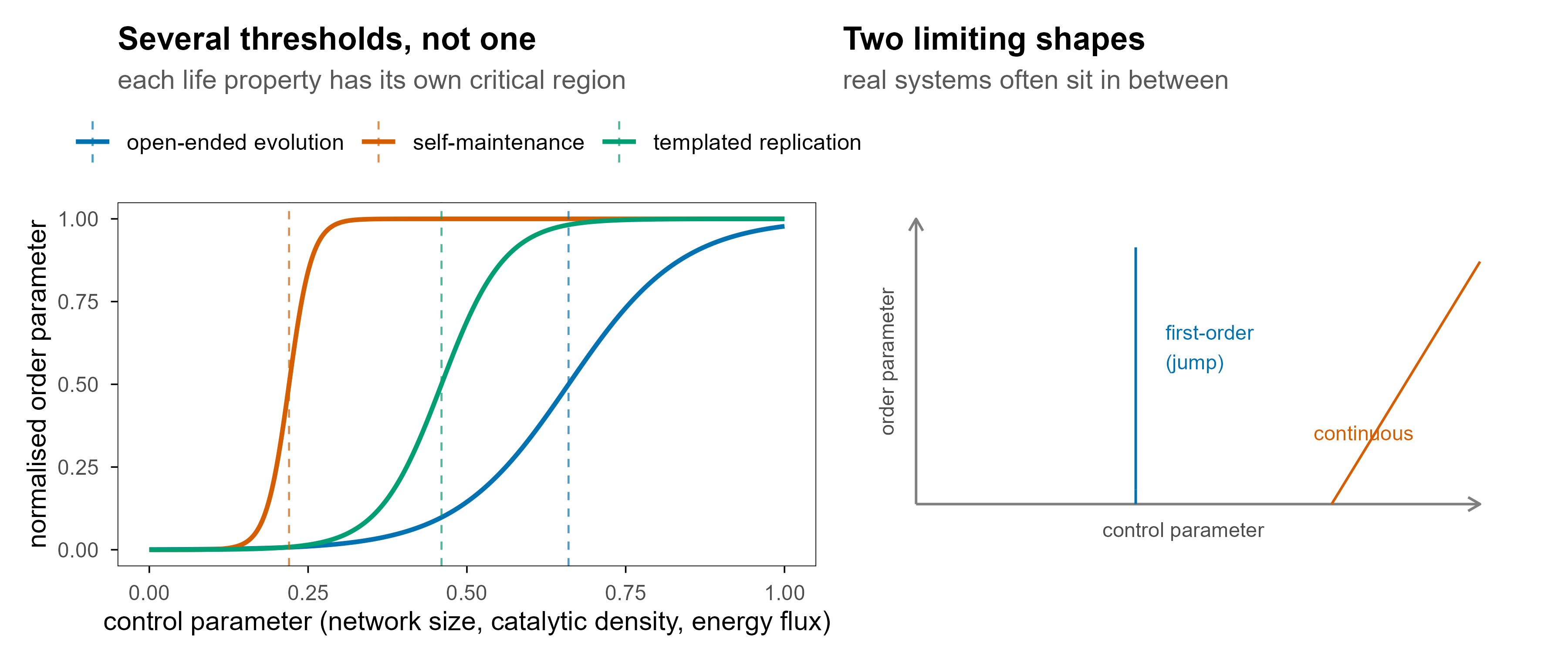
Third tier: phase transitions in the properties of life. Even if an autocatalytic set emerges, does it simultaneously bring “self-maintenance,” “boundary,” and “evolvability”? These three are not the same order parameter. The more likely situation is that they have separate thresholds, located at different positions in parameter space.
5.4 多个序参量,多次跃迁 / 5.4 Multiple Order Parameters, Multiple Transitions
这正是本文的核心判断之一:从非生命到生命不是一个相变,而是一系列相变(或准相变)。
This is one of the central judgements of this article: the transition from non-life to life is not one phase transition but a series of transitions (or quasi-transitions).
Code
x <-seq(0, 1, length.out =400)curves <-bind_rows(data.frame(x = x, y =plogis((x -0.22) /0.018), trait ="self-maintenance"),data.frame(x = x, y =plogis((x -0.46) /0.05), trait ="templated replication"),data.frame(x = x, y =plogis((x -0.66) /0.09), trait ="open-ended evolution"))thr <-data.frame(x =c(0.22, 0.46, 0.66),trait =c("self-maintenance", "templated replication", "open-ended evolution"))p_a <-ggplot(curves, aes(x, y, colour = trait)) +geom_line(linewidth =0.9) +geom_vline(data = thr, aes(xintercept = x, colour = trait),linetype ="dashed", linewidth =0.4, alpha =0.7) +scale_colour_manual(values = pal[c(1, 2, 3)]) +labs(x ="control parameter (network size, catalytic density, energy flux)",y ="normalised order parameter", colour =NULL,title ="Several thresholds, not one",subtitle ="each life property has its own critical region") +theme(legend.position ="top")p_b <-ggplot() +annotate("segment", x =0.05, xend =0.05, y =0, yend =1,arrow =arrow(length =unit(2, "mm")), colour ="grey50") +annotate("segment", x =0.05, xend =1, y =0, yend =0,arrow =arrow(length =unit(2, "mm")), colour ="grey50") +annotate("text", x =0.5, y =-0.09, label ="control parameter", size =3, colour ="grey30") +annotate("text", x =0.0, y =0.5, label ="order parameter", angle =90, size =3, colour ="grey30") +annotate("segment", x =0.42, xend =0.42, y =0, yend =0.05, colour = pal[1]) +annotate("segment", x =0.42, xend =0.42, y =0.05, yend =0.9, colour = pal[1]) +annotate("text", x =0.47, y =0.55, label ="first-order\n(jump)", size =3, colour = pal[1], hjust =0) +annotate("segment", x =0.75, xend =1, y =0, yend =0.85, colour = pal[2]) +annotate("text", x =0.72, y =0.25, label ="continuous", size =3, colour = pal[2], hjust =0) +coord_cartesian(xlim =c(-0.02, 1.05), ylim =c(-0.16, 1)) +labs(title ="Two limiting shapes", subtitle ="real systems often sit in between") +theme_blog() +theme(axis.text =element_blank(), axis.ticks =element_blank(),axis.title =element_blank(), panel.border =element_blank())p_a | p_b
Figure 2: 生命性不是一个序参量。不同的生命属性可能在不同的控制参数处越过各自的阈值:自我维持可能较容易,复制较难,开放式演化最难。曲线的陡峭程度取决于系统大小与噪声——有限系统中阈值会被抹平。 | Aliveness is not a single order parameter. Different properties of life may cross their own thresholds at different values of the control parameter: self-maintenance may be comparatively easy, replication harder, and open-ended evolution hardest. The steepness of the curves depends on system size and noise—in finite systems thresholds are smeared.
至少可以区分出四个候选阈值:
At least four candidate thresholds can be distinguished:
转变
候选序参量
现有证据
自组织 → 自我维持
约束闭合度、恢复能力
模型 + 少量囊泡实验
自我维持 → 复制
模板拷贝数、复制保真度
体外核酶复制已实现
复制 → 选择
变异率 × 群体规模、遗传力
数字演化与体外选择实验
选择 → 开放式演化
新功能出现率、生态位构建能力
只有模型与人工生命中的部分案例
English
Transition
Candidate order parameter
Available evidence
Self-organisation → self-maintenance
Degree of constraint closure, capacity to recover
Models + a few vesicle experiments
Self-maintenance → replication
Template copy number, replication fidelity
In vitro ribozyme replication has been achieved
Replication → selection
Mutation rate × population size, heritability
Digital evolution and in vitro selection experiments
Selection → open-ended evolution
Rate of emergence of new functions, capacity for niche construction
Conflating the four yields the illusion that “life is a single phase transition.” A more accurate formulation is this: the origin of life is a string of threshold events, some of which may be very sharp while others may be long, gradual crossovers.
5.5 为什么不能把生命起源等同于宇宙学奇点 / 5.5 Why the Origin of Life Should Not Be Equated with a Cosmological Singularity
“生命奇点”(life singularity)这个说法在科普中很流行,但它是一个错误的类比:
The phrase “life singularity” is popular in science communication, but it rests on a false analogy:
the Big Bang singularity is the beginning of space-time itself, and all laws of physics break down there, whereas the emergence of life occurs within pre-existing space-time and physico-chemical laws;
奇点是一个唯一事件;生命起源可能在地球上发生过多次(甚至可能多次失败),也可能在宇宙中反复发生。
the singularity is a unique event, whereas the origin of life may have occurred several times on Earth (and may even have failed several times), and may recur elsewhere in the universe;
奇点没有”之前”;生命起源有明确的化学前史。
the singularity has no “before,” whereas the origin of life has a well-defined chemical prehistory.
A more apt analogy is not a cosmological singularity but nucleation in a supercooled liquid: below the critical degree of supercooling, no perturbation can form a stable nucleus; beyond the critical value, the nucleation probability rises steeply. The origin of life may be more like “nucleation”—requiring a local fluctuation to cross a threshold and then amplify itself.
5.6 一次事件还是多次跃迁? / 5.6 One Event or Several Transitions?
The single-transition view: the origin of life is an event of extremely low probability which, once it occurs, rapidly occupies every available niche. Supporters often cite the fact that “all known life shares the same genetic code.”
The multiple-transition view: the origin of life is a series of comparatively easy steps, each with its own chemical basis. Supporters cite the fact that LUCA is already very complex—if every step before LUCA had been extremely difficult, there would not have been enough time.
The parallel-experiment view: several lineages of “primordial life” may have coexisted on Earth, with only one ultimately surviving (competition before the “last universal common ancestor”).
The available evidence favours the second and third: the complexity of LUCA (estimates of roughly 350–500 genes, depending on method) shows that it was not “the first life” but the product of a period of evolution.
Known: in random catalytic network models, the emergence of autocatalytic sets is threshold-like; RAF cores exist in real metabolic networks. Open: do real chemical systems exhibit a first-order phase transition? Are the multiple thresholds causally dependent on one another? Testable direction: systematically scan the parameter “number of catalytic molecules / number of reaction types” in microfluidic devices, measure the shape of the curve of self-maintenance probability against that parameter, and test whether it is a step or a gradual crossover.
第六章 生命作为信息与计算 / Chapter 6. Life as Information and Computation
6.1 两种信息:香农信息与功能信息 / 6.1 Two Kinds of Information: Shannon Information and Functional Information
香农信息(Shannon information)度量的是不确定性减少:
Shannon information measures the reduction of uncertainty:
\[H = -\sum_i p_i \log_2 p_i\]
它完全不管信息”是什么意思”。一段随机比特串可以有很高的香农熵,却不携带任何功能信息。
It says nothing at all about what the information “means.” A random bit string can have very high Shannon entropy yet carry no functional information.
Information in biology is functional: a DNA sequence is information because it is transcribed, translated, and affects the phenotype. At least three additional conditions are required:
编码(encoding):符号与所指之间存在稳定的对应关系;
Encoding: a stable correspondence exists between symbol and referent;
解码机制(decoder):存在一个物理过程把符号转成功能;
A decoder: a physical process exists that converts the symbol into function;
The third point is the most crucial. Without a history of selection there is no “function”—the shape of a stone could also “encode” the structure of a protein, but it is not information, because no mechanism makes use of it.
6.2 遗传信息何时出现? / 6.2 When Does Hereditary Information Appear?
这是生命起源中最尖锐的问题之一。有三种可能的答案:
This is one of the sharpest questions in the origin of life. There are three possible answers:
信息先于复制:在选择出现之前,某些聚合物已经具有”可被读取”的化学性质(例如模板化聚合的选择性)。
Information before replication: before selection appeared, certain polymers already had chemical properties that made them “readable” (for example, the selectivity of templated polymerisation).
复制先于信息:先出现无模板的自催化复制(例如脂质囊泡的生长分裂),信息是后来才被”编码”进去的。
Replication before information: template-free autocatalytic replication appears first (for example, the growth and division of lipid vesicles), and information is “encoded” only later.
信息与复制同时出现:模板复制本身就是信息存储的物理实现,两者不可分。
Information and replication appear together: template replication is itself the physical implementation of information storage, and the two are inseparable.
第三种立场在工程上最自然:复制保真度就是信息容量。一个复制系统能维持多少比特,取决于它的错误率。这正是 Eigen 的贡献。
The third position is the most natural from an engineering standpoint: replication fidelity is information capacity. How many bits a replicating system can maintain depends on its error rate. This is precisely Eigen’s contribution.
6.3 Eigen 的准物种与错误阈值 / 6.3 Eigen’s Quasispecies and the Error Threshold
In 1971, Eigen proposed the theory of quasispecies: at mutation–selection equilibrium, a population of replicating molecules is not a single sequence but a cloud of mutants centred on a master sequence.
The key result is the error threshold. Let the sequence length be \(L\) and the per-base replication accuracy be \(q\); then the probability of copying the whole sequence correctly is \(Q = q^L\). If the relative fitness of the master sequence is \(\sigma\), the condition for the quasispecies to be maintained is approximately:
The inequality states that the longer the genome, the higher the replication fidelity required. For an RNA ribozyme, if the error rate is about \(10^{-3}\) per base, the maximum sustainable length is on the order of \(10^3\) bases—right at the boundary of “enough to encode a useful ribozyme, but not enough to encode a full set of metabolic enzymes.”
This generates the Eigen paradox: without enzymes, replication fidelity is low; without high-fidelity replication, enzymes cannot be encoded. Possible solutions within the RNA world are: start with a small genome plus short-peptide or small-molecule assistance and raise fidelity step by step; or use compartmentalisation (individuation) to lower the effective mutation rate.
6.4 冯·诺依曼:自复制不需要魔法 / 6.4 von Neumann: Self-Replication Requires No Magic
1948 年前后,冯·诺依曼提出了自复制自动机的构造:一个机器包含三部分——
Around 1948, von Neumann proposed the construction of a self-replicating automaton: a machine with three parts—
The significance of this construction is that it proves self-replication requires no mysterious force in logical terms; all it requires is the separation of “description” from “construction,” together with a universal constructor.
It also predicts a profound consequence: any sufficiently powerful self-replicating system will inevitably generate parasites—a “tape” that constructs nothing and merely copies itself. This has been observed repeatedly in Tierra, Avida, and later experiments on digital life.
6.5 编码、解码与语义 / 6.5 Encoding, Decoding, and Semantics
生命系统最特别的地方,可能不是”有信息”,而是有编码。
What is most distinctive about living systems may not be that they “have information” but that they have codes.
在 DNA → RNA → 蛋白质的流程中,三联体密码与氨基酸之间没有化学必然性——这是一个任意映射(arbitrary mapping),只不过被历史固定下来了。这种”任意性 + 稳定性”的组合,是真正意义上的符号系统。
In the DNA → RNA → protein flow, there is no chemical necessity linking a triplet codon to an amino acid—it is an arbitrary mapping that has merely been fixed by history. This combination of “arbitrariness + stability” is a symbolic system in the full sense.
This raises a difficulty: how did the coding system originate? If codons are arbitrary, then before coding appeared there was no “correct” way to decode; yet without a decoding mechanism, coding has no function. This is a classic chicken-and-egg problem.
可能的解决路径包括:
Possible paths to a solution include:
共进化:某些氨基酸与某些 RNA 序列之间的亲和性,最初只是化学偶然,后来被”锁定”为密码;
Coevolution: the affinity between certain amino acids and certain RNA sequences was initially a chemical accident and was later “locked in” as a code;
逐步扩展:先有少数几个氨基酸的简单编码,再逐步扩展密码表;
Gradual expansion: a simple code for a few amino acids comes first, and the code table is then extended stepwise;
功能借用:某些 RNA 本来就有催化功能,后来被”征用”为编码元件。
Functional co-option: some RNAs already had catalytic functions and were later “conscripted” as coding elements.
6.6 Walker、Davies 与”算法起源” / 6.6 Walker, Davies, and the “Origin of Algorithms”
Walker and Davies suggested in 2013 that the origin of life can be understood as the origin of algorithms: for a physical system to become “alive,” it must be able to store and execute an algorithm for “how to maintain itself” (Davies & Walker 2013). They stress that information is not an “extra thing” attached to matter but a correlation among physical states, and that such correlations can be copied, selected, and accumulated.
The advantage of this framework is that it links information to thermodynamics: copying one bit costs energy (the Landauer principle), and natural selection trades off “information accumulation” against “energy dissipation.”
它的困难在于:“算法”这个概念在物理上如何定义? 一段 DNA 是算法,还是数据?一个反应网络是算法,还是动力学?这些问题目前没有公认答案。
Its difficulty is this: how is the concept of an “algorithm” to be defined physically? Is a stretch of DNA an algorithm or data? Is a reaction network an algorithm or dynamics? There is currently no accepted answer to these questions.
2023 年,Cronin、Walker 与合作者在 Nature 发表组装理论(Assembly Theory),提出用两个量刻画复杂对象(Sharma et al. 2023):
In 2023, Cronin, Walker, and collaborators published Assembly Theory in Nature, proposing to characterise complex objects with two quantities (Sharma et al. 2023):
Their core claim is that when \(a \times N\) exceeds a threshold, the object was produced by selection rather than formed at random. Experimentally they used mass spectrometry to measure the assembly index of molecular fragments and claimed to be able to separate living from non-living samples.
这一理论引发了激烈争论,至少有三类批评:
The theory provoked intense debate, with at least three lines of criticism:
Computational complexity: computing the assembly index is NP-hard, and practical algorithms can give only approximations; approximation error bears directly on the “life/non-life” judgement.
理论冗余:有批评者认为,组装理论的核心思想(“复杂 + 大量拷贝 = 选择”)并没有超出已有的演化理论,只是换了一套语言(“Assembly Theory: What It Does and What It Does Not Do”, J Mol Evol 2024)。
Theoretical redundancy: some critics hold that the core idea of assembly theory (“complexity + many copies = selection”) does not go beyond existing evolutionary theory and merely changes the vocabulary (“Assembly Theory: What It Does and What It Does Not Do”, J Mol Evol 2024).
Experimental interpretation: a high assembly index may also arise from abiotic processes (for example, certain minerals or industrial contaminants); treating it as a “biosignature” requires more controlled comparisons.
The judgement of this article is that assembly theory provides a useful quantitative index, especially suited to planetary science and classification problems with scarce samples; but it is not yet a “theory of life,” still less a criterion that can on its own decide “this is life.”
6.8 为什么有些系统能”用过去影响未来” / 6.8 Why Some Systems Can “Use the Past to Affect the Future”
回到本章的核心问题:为什么某些化学系统不再仅由即时条件决定,而能利用保存下来的信息影响未来?
Return to the core question of this chapter: why are certain chemical systems no longer determined solely by instantaneous conditions, but able to use stored information to influence the future?
The physical level: the system contains metastable structures (such as polymers and membranes) whose lifetimes greatly exceed the reaction timescale, so that “past states” are retained.
因果层:这些结构参与后续反应,使系统的当前行为依赖于过去的状态(路径依赖、滞后)。
The causal level: these structures take part in subsequent reactions, so that the current behaviour of the system depends on past states (path dependence, hysteresis).
The selection level: when what is retained is a structure that “raises its own probability of being replicated,” the system possesses functional memory—and this is genuine hereditary information.
In other words: memory is physical; function is a product of selection. A system can “remember” the past (for example through hysteresis) without necessarily “using” it; memory becomes information only when it is repeatedly exploited by a selection mechanism.
6.9 本章结论 / 6.9 Chapter Conclusion
已知:准物种与错误阈值理论给出了复制保真度的定量约束;冯·诺依曼自动机证明了自复制的逻辑可能性;组装指数可以被测量。 未决:编码系统的起源;功能信息能否被定量定义;组装理论的判据在真实样本中的假阳性率。 可验证方向:用体外进化实验测量”复制保真度—基因组长度—适应度”的联合分布,检验 Eigen 阈值在真实核酶系统中的位置;用合成生物学构建”最小编码系统”,观察任意映射如何被锁定。
Known: quasispecies theory and the error threshold give quantitative constraints on replication fidelity; von Neumann’s automaton proves the logical possibility of self-replication; the assembly index can be measured. Open: the origin of coding systems; whether functional information can be defined quantitatively; the false-positive rate of assembly theory’s criterion in real samples. Testable direction: use in vitro evolution experiments to measure the joint distribution of “replication fidelity—genome length—fitness” and locate the Eigen threshold in real ribozyme systems; use synthetic biology to construct a “minimal coding system” and observe how an arbitrary mapping becomes locked in.
第七章 生命何时成为一个独立的个体? / Chapter 7. When Does Life Become an Individual?
7.1 边界的三重作用 / 7.1 The Three Roles of a Boundary
在从化学到生命的转变中,边界(boundary)至少扮演三个角色:
In the transition from chemistry to life, a boundary plays at least three roles:
浓缩:把稀溶液中的反应物限制在微小体积内,提高有效浓度;
Concentration: it confines reactants from a dilute solution within a tiny volume, raising the effective concentration;
保护:把聚合物与水解环境、紫外辐射、捕食者隔开;
Protection: it shields polymers from the hydrolytic environment, ultraviolet radiation, and predators;
区分内外:创造出一个”内部”,从而使”自我”与”环境”的区分成为可能。
Distinguishing inside from outside: it creates an “interior,” making it possible to distinguish “self” from “environment.”
The third role is often underestimated. Without a distinction between inside and outside there can be no “self-maintenance”—since “maintenance” is always maintenance of an organisation within some boundary.
7.2 脂质囊泡:最接近的模型系统 / 7.2 Lipid Vesicles: The Closest Model System
脂肪酸囊泡是目前最成熟的原始细胞模型:
Fatty-acid vesicles are currently the most mature model of a protocell:
脂肪酸在水溶液中自发形成双层囊泡;
fatty acids spontaneously form bilayer vesicles in aqueous solution;
囊泡可以容纳 RNA、酶、荧光染料;
vesicles can encapsulate RNA, enzymes, and fluorescent dyes;
囊泡可以生长(掺入新的脂肪酸)、可以分裂(挤出、剪切、budding);
vesicles can grow (by incorporating new fatty acids) and can divide (by extrusion, shearing, or budding);
膜的通透性可以通过脂肪酸链长、pH、镁离子浓度调节。
membrane permeability can be tuned by fatty-acid chain length, pH, and magnesium concentration.
A series of studies from the Szostak school showed that under suitable conditions, vesicle growth and division can be coupled to the replication of RNA inside. For example, the osmotic pressure of RNA within the membrane can drive vesicle deformation and division, while the synthesis of membrane lipids in turn provides RNA with a stable compartment.
In 2024, a JACS paper demonstrated chemically driven protocell division: fatty-acid vesicles driven by a fuel (chemical energy) produced daughter vesicles through membrane budding, and were able to partition the encapsulated material between the progeny (JACS 2024). The significance of such experiments is that division requires no complex molecular machinery, only the coupling of membrane mechanics to chemical energy.
In 2026, another study demonstrated membrane generation from scratch: using acetate and cysteine as raw materials, soluble enzymes synthesised lipid tails that self-assembled into vesicles and maintained a proton gradient—mitigating the “membrane inheritance paradox” (the idea that membranes need membranes in order to grow) (Nature Communications 2026).
7.3 膜与反应网络的耦合 / 7.3 Coupling Between Membrane and Reaction Network
仅有膜不够,仅有反应网络也不够。真正困难的是耦合:
A membrane alone is not enough, and a reaction network alone is not enough. What is genuinely difficult is the coupling:
膜必须允许原料进入,否则内部反应会停止;
the membrane must admit raw materials, or the internal reactions will stop;
膜必须允许废物排出,否则反应会被抑制;
the membrane must allow waste to leave, or the reactions will be inhibited;
膜脂的合成必须依赖内部反应,否则膜会”独立”于网络,失去约束闭合;
the synthesis of membrane lipids must depend on the internal reactions, or the membrane will become “independent” of the network and constraint closure will be lost;
内部反应不能破坏膜,否则系统会自毁。
the internal reactions must not destroy the membrane, or the system will destroy itself.
These four constraints separate “a vesicle” from “a protocell.” A vesicle packed with enzymes can carry out a reaction once, but cannot maintain itself; only a vesicle that continuously synthesises membrane lipids and maintains a gradient has the basic features of a protocell.
Autonomy has a specific meaning in the philosophy of biology: the system itself determines the norms of its behaviour rather than being directly determined by external inputs. Moreno and Mossio define it as “the system’s continuous self-maintenance of its own conditions of constitution.”
Agency goes further: the system not only maintains itself but can choose among several possible actions and adjust on the basis of the outcome. Minimal agency may require only:
Bacterial chemotaxis is often treated as a paradigm of minimal agency: the cell compares chemical concentrations over time and adjusts the direction of flagellar rotation. There is no “representation” here, but there is functional directedness—the system’s behaviour is directed toward maintaining itself.
In the context of the origin of life, agency may appear before selection: a protocell that can “find” more fatty acids in its environment will grow faster. Such a “preference” requires no nervous system, only physico-chemical selectivity.
In L’individuation (1958), Gilbert Simondon advanced a view very different from mainstream philosophy: the individual is not a pre-existing entity but the provisional result of a process of individuation.
He describes this process with the notions of the “pre-individual” and the “metastable”: a system in a metastable state harbours several possible paths of individuation; when a perturbation occurs, the system “resolves” its own tension and thereby forms an individual—but that individual still carries unresolved tension and can therefore continue to individuate.
The significance of this framework for the origin of life is that “the first life” may not have been a clearly delineated individual but a continuing process of individuation. A population of vesicles is continually growing, dividing, fusing, and exchanging contents; the boundaries of the “individual” are dynamic, permeable, and sometimes even indeterminate.
This also explains why individuality is hard to treat as a necessary condition for life: at the earliest stages of the origin of life, individuality itself may still have been in the making.
7.6 三种”生命候选”的比较 / 7.6 Comparing Three “Candidates for Life”
把前面的内容整理成一张表:
The preceding material can be assembled into a table:
一个复制分子
一套自催化网络
一个原始细胞
边界
无
无(或弱)
有(脂双层)
自我维持
弱(靠外部供给)
强(RAF)
强(约束闭合)
复制
有(模板)
可能有(网络级)
有(基因组)
变异
有(复制错误)
弱
有
选择
有
弱
有
个体性
弱
弱
强
主要缺陷
无法维持自身
无法遗传
复制与膜生长难耦合
English
A replicating molecule
An autocatalytic set
A protocell
Boundary
None
None (or weak)
Yes (lipid bilayer)
Self-maintenance
Weak (relies on external supply)
Strong (RAF)
Strong (constraint closure)
Replication
Yes (template)
Possibly (network level)
Yes (genome)
Variation
Yes (copying errors)
Weak
Yes
Selection
Yes
Weak
Yes
Individuality
Weak
Weak
Strong
Main shortcoming
Cannot maintain itself
Cannot inherit
Replication and membrane growth are hard to couple
三种候选各自满足不同的子集,没有一个是”完整生命”。这再次说明:生命不是一个点,而是一片区域。
The three candidates each satisfy a different subset, and none is “complete life.” This again shows that life is not a point but a region.
Known: fatty-acid vesicles can grow, divide, and encapsulate RNA; chemical energy can drive division; synthesising membrane lipids from scratch has become possible. Open: the quantitative coupling of membrane growth to genome replication; the extent to which individuality is a precondition for life rather than a consequence of it. Testable direction: build a quantitative model coupling “membrane lipid synthesis—RNA replication” and predict under which parameters the system enters stable proliferation; use microfluidics to track the multi-generational evolution of single vesicles.
第八章 2020–2026:实验走到了哪里? / Chapter 8. 2020–2026: How Far Have the Experiments Come?
This chapter is organised not chronologically but by “which class of life property has been demonstrated.” Each study is interrogated with six questions: what was done? What was demonstrated? What is missing? What does it show? Does it demonstrate a transition from non-life to life? What is needed next?
8.1 复制与信息传递 / 8.1 Replication and Information Transfer
(1)三核苷酸底物驱动的指数 RNA 复制(Attwater et al. 2025, Nature Chemistry)
(1) Exponential RNA replication driven by trinucleotide substrates (Attwater et al. 2025, Nature Chemistry)
What was done: an in vitro evolved polymerase ribozyme was used with trinucleotide substrates to copy RNA templates under pH cycles and freeze–thaw cycles.
证明了什么:核酶可以突破”链分离”瓶颈,实现指数式、开放式的复制,且不局限于特定模板。
What was demonstrated: the ribozyme can overcome the “strand separation” bottleneck and achieve exponential, open-ended replication that is not restricted to a particular template.
缺什么:核酶本身是人工进化的产物;三核苷酸的前生物来源未解决;没有区室化。
What is missing: the ribozyme itself is a product of artificial evolution; the prebiotic origin of trinucleotides is unresolved; there is no compartmentalisation.
说明什么:复制保真度与持续性可以同时达到,Eigen 悖论在工程上有一个可行解。
What it shows: replication fidelity and processivity can be achieved at the same time, so the Eigen paradox has a workable engineering solution.
是否证明生命起源:否。这是”复制化学”的突破,不是”原始细胞”的突破。
Does it demonstrate the origin of life: no. This is a breakthrough in “replication chemistry,” not in “protocells.”
下一步:在囊泡内实现同样的复制;用前生物可得的三核苷酸替代物;测量长期演化中的错误率变化。
Next steps: achieve the same replication inside vesicles; use prebiotically plausible substitutes for trinucleotides; measure how the error rate changes over long-term evolution.
(2)甲基异腈化学下的通用模板拷贝(Duzdevich et al. 2024,预印本)
(2) General template copying with methyl isocyanide chemistry (Duzdevich et al. 2024, preprint)
What was done: methyl isocyanide was used to activate mononucleotides together with random oligonucleotide mixtures, copying arbitrary sequence templates, including difficult rA/rU-rich sequences.
证明了什么:非酶促拷贝的序列偏差与错误率可以被显著降低。
What was demonstrated: the sequence bias and error rate of non-enzymatic copying can be markedly reduced.
缺什么:仍依赖人工活化的试剂;拷贝长度有限;需要反复补给。
What is missing: it still relies on artificially activated reagents; copy length is limited; repeated replenishment is required.
说明什么:“非酶促复制”正在从”能连上几个碱基”变成”能比较均匀地拷贝一条模板”。
What it shows: “non-enzymatic replication” is moving from “being able to join a few bases” to “being able to copy a template fairly evenly.”
是否证明生命起源:否,且这是预印本,尚未经过同行评议。
Does it demonstrate the origin of life: no, and this is a preprint that has not yet been peer reviewed.
下一步:在矿物表面或干湿循环中实现试剂的原位再生。
Next steps: achieve in situ regeneration of the reagents on mineral surfaces or through wet–dry cycling.
8.2 边界、分裂与原始细胞 / 8.2 Boundaries, Division, and Protocells
(3)化学能驱动的膜出芽分裂(JACS 2024)
(3) Membrane budding and division driven by chemical energy (JACS 2024)
做了什么:以化学燃料驱动脂肪酸囊泡出芽,产生子囊泡,并保留包裹物。
What was done: a chemical fuel was used to drive budding of fatty-acid vesicles, producing daughter vesicles that retained the encapsulated contents.
证明了什么:分裂不需要蛋白质机器,只需要膜力学与化学能输入;分裂具有可调性。
What was demonstrated: division requires no protein machinery, only membrane mechanics and an input of chemical energy; division is tunable.
缺什么:子代大小分布不均;没有基因组复制;多代稳定性未知。
What is missing: the size distribution of the progeny is uneven; there is no genome replication; multi-generational stability is unknown.
说明什么:原始细胞分裂的物理门槛比想象中低。
What it shows: the physical threshold for protocell division is lower than one might imagine.
是否证明生命起源:否。证明了”分裂”这一单项功能。
Does it demonstrate the origin of life: no. It demonstrates the single function of “division.”
下一步:让分裂频率与内部反应速率耦合,形成”生长—分裂”的负反馈。
Next steps: couple the division frequency to the rate of internal reactions, creating a “growth–division” negative feedback.
What was done: a two-phase reaction network was constructed so that a vesicle population exhibits periodic self-replication–disintegration oscillations, and individual vesicles were tracked with interferometric scattering microscopy.
证明了什么:囊泡群体可以表现出群体层面的自维持动力学,而不只是单个囊泡的瞬时行为。
What was demonstrated: a vesicle population can exhibit population-level self-maintaining dynamics, not merely the transient behaviour of individual vesicles.
缺什么:振荡由外部燃料维持,系统不能”自己决定”何时分裂;没有遗传。
What is missing: the oscillations are sustained by external fuel, and the system cannot “decide for itself” when to divide; there is no heredity.
说明什么:群体动力学可以成为选择的单位。
What it shows: population dynamics can become the unit of selection.
是否证明生命起源:否。
Does it demonstrate the origin of life: no.
下一步:引入可遗传的膜组成差异,观察振荡是否会”选择”某些组成。
Next steps: introduce heritable differences in membrane composition and observe whether the oscillations “select” certain compositions.
(5)从零生成膜:打破”膜遗传悖论”(Nature Communications 2026)
(5) Generating membranes from scratch: breaking the “membrane inheritance paradox” (Nature Communications 2026)
做了什么:以乙酸与半胱氨酸为原料,用可溶性酶合成脂质尾链,自组装成囊泡,并维持质子梯度。
What was done: using acetate and cysteine as raw materials, soluble enzymes synthesised lipid tails that self-assembled into vesicles and maintained a proton gradient.
证明了什么:膜可以在没有现成膜、没有膜蛋白、没有模板的条件下生成。
What was demonstrated: membranes can be generated without pre-existing membranes, without membrane proteins, and without a template.
缺什么:酶是外加的;系统不能自主复制酶;长期稳定性未知。
What is missing: the enzymes are supplied externally; the system cannot replicate the enzymes autonomously; long-term stability is unknown.
说明什么:原始细胞不必”继承”膜,可以从代谢产物中重新生成膜。
What it shows: a protocell need not “inherit” its membrane; it can regenerate membranes from metabolic products.
是否证明生命起源:否,但这是”约束闭合”最接近的实验演示之一。
Does it demonstrate the origin of life: no, but this is one of the closest experimental demonstrations of “constraint closure.”
下一步:把脂质合成酶也纳入同一反应网络,形成”酶—膜”互惠。
Next steps: bring the lipid-synthesising enzymes into the same reaction network, creating an “enzyme–membrane” reciprocity.
(6)活性聚合驱动的相分离原始细胞(PNAS 2025)
(6) Phase-separated protocells driven by active polymerisation (PNAS 2025)
做了什么:建立包含自发聚合与燃料驱动聚合的模型,观察液滴的滞后与稳健性。
What was done: a model incorporating spontaneous and fuel-driven polymerisation was built to examine the hysteresis and robustness of droplets.
证明了什么:无膜区室可以在燃料耗尽后仍保持结构,从而抵抗环境波动。
What was demonstrated: membraneless compartments can retain their structure after the fuel is exhausted, thereby resisting environmental fluctuations.
缺什么:这是模型,不是实验;没有遗传信息。
What is missing: this is a model, not an experiment; there is no hereditary information.
说明什么:原始细胞不一定要有脂膜,凝聚体也可以提供区室化。
What it shows: a protocell need not have a lipid membrane; coacervates can also provide compartmentalisation.
是否证明生命起源:否。
Does it demonstrate the origin of life: no.
8.3 自催化与反应网络 / 8.3 Autocatalysis and Reaction Networks
What was done: Ca²⁺, La³⁺, and Nd³⁺ were used to regulate a trypsin-catalysed autocatalytic network, altering the character of the positive feedback and producing time- and history-dependent outputs.
证明了什么:自催化网络可以被外部输入”编程”,表现出类似逻辑门与记忆的行为。
What was demonstrated: an autocatalytic network can be “programmed” by external inputs, exhibiting behaviour resembling logic gates and memory.
缺什么:网络不能自我维持,需要持续供给底物与酶;没有演化。
What is missing: the network cannot maintain itself and requires a continuous supply of substrate and enzyme; there is no evolution.
说明什么:“化学计算”与”化学记忆”在实验上是可实现的。
What it shows: “chemical computation” and “chemical memory” are experimentally realisable.
是否证明生命起源:否。
Does it demonstrate the origin of life: no.
(8)最小自催化剂的生长定律与竞争(Communications Chemistry 2024)
(8) Growth laws and competition of minimal autocatalysts (Communications Chemistry 2024)
做了什么:系统分析最简单的自催化剂——通过模板连接自我复制的二聚体——的动力学。
What was done: the kinetics of the simplest autocatalyst—a dimer that replicates itself through template ligation—were analysed systematically.
What was demonstrated: even such a simple system can achieve exponential growth; moreover, sub-exponentially growing autocatalysts can outcompete exponential growers when competing for a shared resource.
说明什么:这挑战了”生命必然选择最快复制者”的直觉,提示早期选择可能偏好”稳健”而非”快速”。
What it shows: this challenges the intuition that “life necessarily selects the fastest replicator” and suggests that early selection may favour “robustness” over “speed.”
是否证明生命起源:否,且这是理论/模型工作。
Does it demonstrate the origin of life: no; this is theoretical and modelling work.
(9)真实代谢网络中的 RAF(Xavier et al. 2020, Proc R Soc B)
(9) RAFs in real metabolic networks (Xavier et al. 2020, Proc R Soc B)
做了什么:在厌氧自养微生物的代谢网络中搜索 RAF。
What was done: RAFs were searched for in the metabolic networks of anaerobic autotrophs.
证明了什么:存在能生成乙酰辅酶 A、氨基酸与碱基的自维持网络核;有机催化剂是必要的。
What was demonstrated: a self-sustaining network core exists that generates acetyl-CoA, amino acids, and bases; organic catalysts are necessary.
缺什么:这是对现存代谢网络的回溯分析,不是对早期地球的模拟。
What is missing: this is a retrospective analysis of extant metabolic networks, not a simulation of the early Earth.
说明什么:现代代谢的拓扑结构保留了”可自催化”的痕迹。
What it shows: the topology of modern metabolism retains traces of “autocatalytic capability.”
是否证明生命起源:否,但为”代谢优先”提供了最强的计算证据之一。
Does it demonstrate the origin of life: no, but it provides one of the strongest computational arguments for “metabolism-first.”
8.4 理论与人工生命 / 8.4 Theory and Artificial Life
(10)自催化集合作为一阶相变(Kauffman & Roli 2025):理论框架,主张小分子、肽、RNA 自催化集合按一阶相变出现,并融合为更高阶的康德式整体。证明的是模型内部的自洽性,不是自然界的实际历史。
(10) Autocatalytic sets as a first-order phase transition (Kauffman & Roli 2025): a theoretical framework claiming that autocatalytic sets of small molecules, peptides, and RNA arise through a first-order phase transition and merge into higher-order Kantian wholes. What it establishes is the internal consistency of the model, not the actual history of nature.
(11)组装理论(Sharma et al. 2023, Nature):提供了可测量的复杂度指标,并在质谱数据上做了演示。争议见 6.7 节。
(11) Assembly theory (Sharma et al. 2023, Nature): it provides a measurable index of complexity and was demonstrated on mass-spectrometric data. For the controversy, see Section 6.7.
(12)随机程序中出现自复制子(Agüera y Arcas et al. 2024,预印本):在没有适应度景观的随机程序中,自复制程序自发出现,并伴随寄生者与共生融合。这是计算实验,不是化学实验。
(12) Self-replicators emerging among random programs (Agüera y Arcas et al. 2024, preprint): in random programs with no fitness landscape, self-replicating programs appeared spontaneously, accompanied by parasites and symbiotic mergers. This is a computational experiment, not a chemical one.
(13)虚拟人工生命的起源综述(Phil Trans R Soc B 2025):系统梳理了数字生命中的开放式演化问题,指出经典系统(Tierra、Avida)普遍在初期创新后停滞。
(13) A review of the origins of virtual artificial life (Phil Trans R Soc B 2025): it systematically surveys the problem of open-ended evolution in digital life and notes that the classic systems (Tierra, Avida) generally stagnate after an initial burst of innovation.
(14) A roadmap for synthetic cells (Nature Communications 2025): it summarises the modules required to build a synthetic cell (minimal genome, membrane, metabolism, division) and states explicitly that no combination of modules yet achieves a complete closed loop of autonomous growth and division.
8.5 早期地球与化学基础 / 8.5 The Early Earth and Chemical Foundations
(15)冥古宙时间线(Mojzsis et al. 2026, Nature Communications):给出 4.33 Ga 的”甜点窗口”,属于模型推断。
(15) The Hadean timeline (Mojzsis et al. 2026, Nature Communications): it proposes the 4.33 Ga “sweet spot” window, which is a model inference.
(16) Homochirality in prebiotic networks (PNAS 2025): it discusses how chiral consistency can be achieved across an entire prebiotic network rather than in individual molecules, emphasising that the genome is the key locus of chiral selection.
(17) A thermodynamic path from origin to emergence (Life 2024): it argues that chemiosmotic processes are the thermodynamically most parsimonious starting point for life.
8.6 一张对照表 / 8.6 A Comparison Table
研究
核心成果
证明的生命属性
仍缺失
是否等于”创造生命”?
Attwater 2025
指数 RNA 复制
复制、开放性
区室、前生物可行性
否
Duzdevich 2024(预印本)
通用模板拷贝
复制保真度
区室、自主供能
否
JACS 2024(budding)
化学驱动分裂
分裂
遗传、耦合
否
JACS 2024(oscillation)
群体自复制振荡
群体自维持
遗传、自主性
否
Nat Commun 2026
从零生成膜
约束闭合
自主复制
否
PNAS 2025
相分离稳健性
区室化、稳健性
信息
否
Nat Commun 2024
可编程自催化网络
化学计算、记忆
自我维持
否
Comm Chem 2024
最小自催化剂竞争
选择
网络闭合
否
Xavier 2020
代谢 RAF
自催化闭合
历史证据
否
Kauffman & Roli 2025
相变理论
(理论)
实验验证
否
Sharma 2023
组装指数
选择的可测指标
特异性
否
Agüera y Arcas 2024
数字自复制子
演化
化学实现
否
Mojzsis 2026
Hadean 时间窗
(环境约束)
地质证据
否
English
Study
Core result
Life property demonstrated
Still missing
Equivalent to “creating life”?
Attwater 2025
Exponential RNA replication
Replication, openness
Compartmentalisation, prebiotic feasibility
No
Duzdevich 2024 (preprint)
General template copying
Replication fidelity
Compartmentalisation, autonomous energy supply
No
JACS 2024 (budding)
Chemically driven division
Division
Heredity, coupling
No
JACS 2024 (oscillation)
Population-level self-replication oscillation
Population-level self-maintenance
Heredity, autonomy
No
Nat Commun 2026
Generating membranes from scratch
Constraint closure
Autonomous replication
No
PNAS 2025
Robustness of phase separation
Compartmentalisation, robustness
Information
No
Nat Commun 2024
Programmable autocatalytic network
Chemical computation, memory
Self-maintenance
No
Comm Chem 2024
Competition among minimal autocatalysts
Selection
Network closure
No
Xavier 2020
Metabolic RAF
Autocatalytic closure
Historical evidence
No
Kauffman & Roli 2025
Phase-transition theory
(Theory)
Experimental validation
No
Sharma 2023
Assembly index
A measurable indicator of selection
Specificity
No
Agüera y Arcas 2024
Digital self-replicators
Evolution
Chemical implementation
No
Mojzsis 2026
Hadean time window
(Environmental constraint)
Geological evidence
No
8.7 怎样读这些论文:五个追问 / 8.7 How to Read These Papers: Five Questions
Does the system maintain itself “by itself”? If every step requires the experimenter to add reagents, adjust pH, and change buffer, then it is still far from “autonomous.”
有没有”代际”? 一次性的反应不是演化;必须有多代、有变异、有选择。
Are there “generations”? A one-off reaction is not evolution; there must be multiple generations, variation, and selection.
选择的是什么? 是分子序列、膜组成、还是液滴大小?选择单位决定了系统的”个体性”。
What is being selected? Molecular sequence, membrane composition, or droplet size? The unit of selection determines the “individuality” of the system.
扰动后能否恢复? 这是区分”结构”与”组织”的关键实验。
Can it recover after perturbation? This is the decisive experiment for distinguishing “structure” from “organisation.”
如果移除研究者,系统能维持多久? 这是最严酷也最有意义的检验。
If the researcher is removed, how long can the system persist? This is the harshest and most meaningful test.
Known: replication, division, compartmentalisation, autocatalytic networks, and chemical memory have each been realised separately; RAF cores exist in metabolic networks; phase-transition theory rests on a rigorous model basis. Open: no single system yet possesses “self-maintenance + replication + selection + open-ended evolution” at once; no experiment has shown that a phase transition occurred in nature. Testable direction: place the “replication module” and the “membrane growth module” in the same vesicle and measure multi-generational stability; establish a standardised “life-likeness report” requiring every study to report perturbation recovery, number of generations, and unit of selection.
第九章 如果生命可以计算,人工生命是否可能? / Chapter 9. If Life Can Be Computed, Is Artificial Life Possible?
9.1 弱人工生命与强人工生命 / 9.1 Weak and Strong Artificial Life
When Langton proposed “Artificial Life” in 1989, his programme was this: life is a property of the organisation of matter, not of particular molecules; consequently, the “general logic of life” can be studied on silicon or in other substrates.
Weak ALife: computational models are simulations of certain aspects of life, intended to help us understand mechanisms. The model need not “really be alive.”
Strong ALife: if a computational system realises the same organisation and causal structure, it really is life, not merely a simulation.
这场争论与心灵哲学中的”模拟 vs 实现”问题同构。支持强 ALife 的论证依赖于基质独立性(substrate independence):如果生命的功能由组织决定,那么基质无关紧要。反对者则指出:生命依赖于具体的物理过程(能量耗散、化学键、空间嵌入),这些在纯符号系统中没有对应物。
This debate is isomorphic to the “simulation versus realisation” problem in the philosophy of mind. Arguments for strong ALife rely on substrate independence: if the functions of life are determined by organisation, then the substrate does not matter. Opponents point out that life depends on specific physical processes (energy dissipation, chemical bonds, spatial embedding) that have no counterpart in a purely symbolic system.
9.2 经典系统及其局限 / 9.2 Classic Systems and Their Limitations
Conway’s Game of Life (1970): it showed that simple rules can generate “emergent” structures such as gliders and oscillators, but it has no replication, no selection, and no metabolism.
Tierra (Ray, 1991): self-replicating machine code competes within limited memory, and parasites and hyperparasites appear. It offered the first glimpse of a “digital ecology.”
Avida(Adami、Ofria 等):在 Tierra 的基础上加入了可测量的”基因组”与适应度,被广泛用于演化实验。
Avida (Adami, Ofria, and others): it added a measurable “genome” and fitness to the Tierra framework and has been widely used in evolution experiments.
Polyworld、EcoSim 等:加入神经网络与生态互动。
Polyworld, EcoSim, and others: these added neural networks and ecological interactions.
The shared achievement of these systems is that they demonstrate evolution can occur on a non-biological substrate; the shared limitation is that they all tend to stagnate after initial innovation—once the system has explored the possibilities permitted by its rules, novelty runs dry. This is the problem of “open-ended evolution.”
9.3 开放式演化:定义与困难 / 9.3 Open-Ended Evolution: Definitions and Difficulties
Packard、Taylor 等人把开放式演化(OEE)分为四类(Packard et al. 2019):
Packard, Taylor, and others divide open-ended evolution (OEE) into four categories (Packard et al. 2019):
持续产生新的实体类型与相互作用;
the continual generation of new types of entities and interactions;
演化出”可演化性”(evolvability);
the evolution of “evolvability”;
出现重大演化转变(major transitions);
the occurrence of major evolutionary transitions;
语义演化(semantic evolution)——符号与所指的关系本身在变化。
semantic evolution—the relation between symbol and referent is itself changing.
The difficulty is that in a simulation with fixed rules the space of possibilities is closed. One can keep discovering new combinations, but one cannot produce anything “outside the rules.” Genuine OEE may therefore require:
规则本身可演化(如可自我修改的程序);
rules that are themselves evolvable (for example, self-modifying programs);
系统与环境的边界可渗透;
a permeable boundary between system and environment;
观察者的表征参与定义”新奇”。
the observer’s representation participating in the definition of “novelty.”
9.4 2024 年的一个转折:随机程序中的自复制 / 9.4 A Turning Point in 2024: Self-Replication Among Random Programs
2024 年,Agüera y Arcas 与合作者发表了一个引人注目的结果(预印本):在一个极简的”计算汤”中,随机的、非自复制的程序被反复执行、拼接、取回;经过数百万次交互后,自复制程序自发出现,并在没有显式适应度函数的情况下扩散、变异,甚至出现寄生与共生。
In 2024, Agüera y Arcas and collaborators published a striking result (preprint): in a minimal “computational soup,” random, non-self-replicating programs were repeatedly executed, concatenated, and retrieved; after millions of interactions, self-replicating programs appeared spontaneously and spread and mutated in the absence of any explicit fitness function, even giving rise to parasitism and symbiosis.
The importance of this result is that it shows self-replication need not be “designed in”; all that is required is a substrate permitting programs to interact and modify themselves. It also exhibits “symbiotic merger” (two replicators combining into a more complex one)—precisely a computational analogue of Margulis-style endosymbiosis.
But restraint is required: this is a computational experiment, and what it shows is “emergence under particular rules,” not “life necessarily appears.” The choice of rules is itself a strong assumption.
9.5 AI 与人工生命:两个不同的目标 / 9.5 AI and Artificial Life: Two Different Goals
近两年,生成式模型与世界模型被引入人工生命研究。例如有工作用基础模型作为”观察者”,在模拟空间中搜索”有趣”的行为,以自动化地发现新的生命形态(Kumar et al. 2024,预印本)。
Over the past two years, generative models and world models have been introduced into artificial life research. One line of work, for example, uses foundation models as “observers” that search a simulated space for “interesting” behaviour, in order to discover new life forms automatically (Kumar et al. 2024, preprint).
这里必须区分两个目标:
Two goals must be distinguished here:
用 AI 研究生命:模型作为工具,帮助我们搜索参数空间、提出假设、压缩实验数据。这非常有价值,但模型本身不是生命。
Using AI to study life: the model serves as a tool that helps us search parameter spaces, generate hypotheses, and compress experimental data. This is extremely valuable, but the model itself is not alive.
Building computational systems that themselves have the properties of life: such a system must self-maintain, replicate, vary, and evolve open-endedly. This is an entirely different engineering goal from “a model that predicts life.”
把两者混为一谈,是当前 AI 时代最容易出现的概念错误。一个能完美预测细菌行为的模型,不比一本教科书更”活”。
Conflating the two is the most likely conceptual error of the present AI era. A model that predicts bacterial behaviour perfectly is no more “alive” than a textbook.
9.6 计算系统能有真正的自主性吗? / 9.6 Can Computational Systems Have Genuine Autonomy?
If autonomy is defined as “the system maintaining its own conditions of constitution,” purely software systems face a fundamental difficulty: their conditions of existence are supplied from outside—electricity, an operating system, memory management, and permissions that prevent deletion. They cannot maintain their own physical substrate.
The counter-argument is that a biological cell cannot maintain its own laws of physics either; it maintains only its own organisation. A software system can likewise maintain its own organisation (for example through self-modifying code and error recovery). The difference may lie only in “the depth of substrate dependence.”
Known: digital systems can evolve, can produce parasites and symbioses, and can generate self-replicators in the absence of an explicit fitness function. Open: can open-ended evolution be genuinely realised in a system with fixed rules? Is the “autonomy” of software systems merely a metaphor? Testable direction: design a set of “perturbation–recovery–generation” tests for comparing the autonomy of digital and biological systems; establish a cross-substrate scale for scoring aliveness.
第十章 生命是偶然,还是宇宙的必然? / Chapter 10. Is Life Contingent, or Necessary in the Universe?
Contingency. In Chance and Necessity (1970), Monod writes that the universe does not “gestate” life; the emergence of life is an event of extremely low probability, subsequently amplified by natural selection, that “machine of necessity.” His argument rests on two observations: mutation at the molecular level is random, and the biochemical architecture of life (especially the genetic code) shows no obvious physical necessity.
Necessity. In Blueprint for a Cell (1991), de Duve takes the opposite view: given the chemical conditions of the early Earth, life is a “cosmic imperative.” His argument is that chemical reactions have directionality, that certain pathways (phosphorylation, polymerisation) are thermodynamically and kinetically “easy,” and that given enough time life will appear.
Kauffman’s position lies between the two: individual molecular events are contingent, but the emergence of autocatalytic networks is statistically inevitable. He likens the origin of life to a phase transition—it is not that some particular molecule must appear, but that once network density passes a threshold, “self-maintenance” appears almost inevitably.
10.2 选择能在生命之前发生吗? / 10.2 Can Selection Occur Before Life?
If “Darwinian evolution” is written into the definition of life, then there can be no selection before any life appears—which lands us in a circle. The way out is to acknowledge the existence of prebiotic selection:
矿物表面选择:不同分子在矿物表面的吸附强度不同,导致组成富集;
Mineral surface selection: different molecules adsorb to mineral surfaces with different strengths, leading to compositional enrichment;
囊泡组成选择:不同脂质比例的囊泡在生长与分裂速率上有差异,且这种差异可以传给子代囊泡;
Vesicle composition selection: vesicles with different lipid ratios differ in growth and division rates, and this difference can be passed on to daughter vesicles;
复制错误选择:即使没有酶,模板拷贝的错误率也有差异,某些序列被更忠实地复制。
Copying-error selection: even without enzymes, template copying error rates differ, and certain sequences are copied more faithfully.
All of these mechanisms satisfy the minimal conditions of “variation + heredity + differential fitness” without any genome. Hence selection can precede genes but not replication—and “replication” can be compositional rather than templated.
10.3 必然性的证据与反证 / 10.3 Evidence For and Against Necessity
Chemical convergence: amino acids, nucleobases, and fatty acids recur in meteorites, comets, and laboratory syntheses; the prebiotic synthetic pathways to these molecules overlap.
热力学驱动:氧化还原不平衡(H₂ + CO₂)在地球、火星、土卫二、木卫二上都存在。
Thermodynamic drive: redox disequilibria (H₂ + CO₂) exist on Earth, Mars, Enceladus, and Europa.
自组织普适性:自催化、相分离、耗散结构在参数合适时普遍出现。
The universality of self-organisation: autocatalysis, phase separation, and dissipative structures appear widely when the parameters are right.
支持”生命可能罕见”的证据:
Evidence that life may be rare:
样本量为 1:我们只知道一种生化方案,无法估计”其他方案”的概率。
A sample size of one: we know only one biochemical scheme and cannot estimate the probability of “other schemes.”
The complexity of LUCA: LUCA already had a complete translation system, energy metabolism, and membrane systems; the path from chemistry to LUCA may be very narrow.
时间窗口:地球在 4.4–3.8 Ga 之间经历了剧烈撞击;如果生命起源需要长期稳定的环境,窗口可能很窄(Mojzsis et al. 2026)。
The time window: the Earth suffered violent impacts between 4.4 and 3.8 Ga; if the origin of life required a long period of stable conditions, the window may have been narrow (Mojzsis et al. 2026).
10.4 非地球生物化学的可能性 / 10.4 The Possibility of Non-Terrestrial Biochemistry
如果生命是组织规律而非特定物质,那么理论上可以存在:
If life is a regularity of organisation rather than a particular substance, then in principle the following could exist:
硅基化学:硅–氧键网络丰富,但硅烷在水中的不稳定性是硬约束;
Silicon-based chemistry: silicon–oxygen networks are abundant, but the instability of silanes in water is a hard constraint;
氨溶剂:低温下氨可以充当溶剂,但可用能量梯度与溶解度窗口不同;
Ammonia as solvent: at low temperatures ammonia can serve as a solvent, but the available energy gradients and solubility windows differ;
These proposals remain at the conceptual level. Their methodological value is that they help us separate “the necessary conditions for life” from “the contingent features of terrestrial life.” Water, for example, may not be a necessary condition, whereas “a polar solvent + a redox gradient + polymerisable monomers” may be.
10.5 如果宇宙重新开始 / 10.5 If the Universe Started Over
这是一个无法直接检验的反事实问题,但可以拆成可讨论的子问题:
This is a counterfactual question that cannot be tested directly, but it can be broken into discussable sub-questions:
物理常数不变:化学规律相同,因此某些反应路径仍然”容易”;生命可能以相似的化学形式出现。
Physical constants unchanged: the laws of chemistry are the same, so certain reaction pathways remain “easy”; life may appear in a similar chemical form.
初始条件不同:如果地球没有液态水或没有板块运动,生命可能出现得更晚,或以完全不同的形式出现。
Different initial conditions: if the Earth had no liquid water or no plate tectonics, life might have appeared later, or in an entirely different form.
The role of chance events: if the origin of life depended on a few molecular events of extremely low probability (such as the spontaneous appearance of a particular ribozyme sequence), then a rerun might not produce it at all.
The most honest answer at present is: we do not know. And “we do not know” is itself a valuable conclusion—it shows that we need more quantitative work on “how large the space of prebiotic chemistry is, and how many pathways within it lead to self-sustaining systems.”
Known: prebiotic selection mechanisms exist in the laboratory and in models; chemical convergence supports the “easiness” of certain molecular pathways. Open: the probability of the origin of life cannot be estimated from a single sample; non-terrestrial biochemical schemes lack empirical support. Testable direction: use combinatorial chemistry and high-throughput experiments to estimate “the density of pathways leading to self-sustaining networks”; use Bayesian models to integrate evidence from Earth, Mars, and icy moons into probability intervals.
第十一章 我们应该怎样定义”生命发生了”? / Chapter 11. How Should We Define “Life Has Occurred”?
A dilemma recurs throughout the preceding chapters: any “checklist definition” is punctured by boundary cases. A workable alternative is to decompose aliveness into a number of independently measurable dimensions:
维度
可操作判据
测量方法
备注
D1 物质与能量流
与环境交换物质,维持非平衡
代谢通量、热耗散
火焰也满足
D2 自我维持
去除外部扰动后恢复组织
扰动—恢复实验
区分结构与组织
D3 边界
存在选择性通透的界面
膜电位、渗透实验
凝聚体是弱边界
D4 信息存储
存在可被读取的亚稳态结构
序列/组成分析
需有解码机制
D5 复制
产生与自身相似的实体
代际追踪
需区分模板与非模板
D6 可遗传变异
子代差异可稳定传递
亲子相关性
遗传力
D7 选择
差异适应度导致频率变化
群体时间序列
需排除漂变
D8 自主性
系统自身设定行为规范
扰动下的目标维持
哲学争议大
D9 开放式创新
持续产生新组织层次
长期演化实验
最难测量
English
Dimension
Operational criterion
Measurement method
Note
D1 Matter and energy flow
Exchanges matter with the environment, maintains non-equilibrium
Metabolic flux, heat dissipation
Flames also satisfy this
D2 Self-maintenance
Restores organisation after external perturbation is removed
Perturbation–recovery experiments
Distinguishes structure from organisation
D3 Boundary
Presence of a selectively permeable interface
Membrane potential, osmotic experiments
Condensates are weak boundaries
D4 Information storage
Presence of a metastable structure that can be read
Sequence/composition analysis
Requires a decoding mechanism
D5 Replication
Produces entities similar to itself
Generation tracking
Must distinguish templated from non-templated
D6 Heritable variation
Offspring differences can be transmitted stably
Parent–offspring correlation
Heritability
D7 Selection
Differential fitness leads to frequency change
Population time series
Must rule out drift
D8 Autonomy
The system sets its own norms of behaviour
Goal maintenance under perturbation
Highly contested philosophically
D9 Open-ended innovation
Continuously generates new levels of organisation
Long-term evolution experiments
Hardest to measure
11.2 三种定义策略的比较 / 11.2 Comparing Three Definitional Strategies
属性清单式:列出必要属性,满足即算生命。优点是易操作;缺点是边界模糊,且不同清单互相矛盾。
Property checklists: list the necessary properties, and whatever satisfies them counts as life. The advantage is ease of use; the disadvantage is that the boundaries are fuzzy and different checklists contradict one another.
Dynamical-systems definitions: define life as a kind of attractor or structure in state space (for example, “a self-maintaining state far from equilibrium”). The advantage is mathematical clarity; the disadvantage is that many non-living systems are included.
Causal-organisation definitions: define life as a constraint-closed causal structure (autopoiesis, autonomy). The advantage is that it captures the core notion of “being about oneself”; the disadvantage is that it is hard to quantify.
This article favours the third as primary and the first as auxiliary: causal organisation gives the qualitative answer to “what life is,” while the property checklist gives the quantitative answer to “how much like life something is.”
11.3 一个渐进式评价框架(作者提议,非共识) / 11.3 A Graduated Assessment Framework (a Proposal, Not a Consensus)
下面这个框架是本文提出的操作性建议,不是学术界的共识。它的目的是让不同实验之间的结果可以比较。
The framework below is an operational proposal advanced by this article, not a consensus of the field. Its purpose is to make results from different experiments comparable.
评分规则:每个维度 0–3 分。
Scoring rule: each dimension is scored from 0 to 3.
0:完全缺失;
0: entirely absent;
1:被动出现,依赖外部维持;
1: present passively and dependent on external maintenance;
2:系统自身参与维持,但需要频繁干预;
2: the system participates in its own maintenance, but frequent intervention is required;
3:系统自主维持,且能抵抗中等扰动。
3: the system maintains itself autonomously and can resist moderate perturbations.
分级建议(仅为工作性阈值):
Suggested bands (working thresholds only):
总分
类别
典型例子
0–5
非生命复杂系统
火焰、BZ 反应、晶体
6–10
前生命系统
自催化网络、脂质囊泡
11–16
原始生命候选
能生长分裂并复制的囊泡系统
17–21
生命
细菌(应有尽有)
22–27
开放式生命
具有开放式演化的系统(目前只有地球生物圈)
English
Total
Category
Typical example
0–5
Non-living complex systems
Flames, BZ reactions, crystals
6–10
Pre-life systems
Autocatalytic networks, lipid vesicles
11–16
Protocell candidates
Vesicle systems that can grow, divide, and replicate
17–21
Life
Bacteria (everything one could ask for)
22–27
Open-ended life
Systems with open-ended evolution (currently only the terrestrial biosphere)
使用这个框架时必须同时报告:
Use of this framework must be accompanied by reporting:
每个维度的测量方法与不确定度;
the measurement method and uncertainty for each dimension;
系统在去除研究者干预后的维持时间;
how long the system persists once researcher intervention is withdrawn;
观察到的代数与选择单位;
the observed number of generations and the unit of selection;
哪些维度是”设计进去的”,哪些是”涌现出来的”。
which dimensions were “designed in” and which “emerged.”
The last point is especially important. A system painstakingly assembled by researchers, with every component designed for a specific function, does not show that “life can arise spontaneously” even if it scores highly—it shows that “life can be engineered.”
11.4 可证伪的预测 / 11.4 Falsifiable Predictions
一个好的框架应该产生可被推翻的预测。本文提出三条:
A good framework should generate predictions that can be overturned. This article offers three:
Perturbation-recovery prediction: under otherwise equal conditions, systems scoring ≥ 11 should recover significantly faster after osmotic perturbation than systems scoring ≤ 10.
代际稳定性预测:具备 D5 + D6 的系统,其子代分布应随代数收敛(而不是发散)。
Generational-stability prediction: in systems possessing D5 + D6, the distribution of progeny should converge (not diverge) with successive generations.
Open-ended innovation prediction: only systems possessing D8 + D9 should continue to produce “new types” in long-term culture, rather than merely drifting in parameter space.
如果这些预测在实验中失败,框架就需要修正——这正是它区别于纯哲学分类的地方。
If these predictions fail experimentally, the framework must be revised—and that is precisely what distinguishes it from a purely philosophical taxonomy.
Known: the checklist, dynamical-systems, and causal-organisation definitions each have strengths and weaknesses; there is no accepted quantitative framework. Open: are the dimensions independent of one another? Is there a “necessary combination”? Testable direction: test 5–10 artificial systems (vesicles, coacervates, autocatalytic networks, minimal cells) with the same perturbation protocol and compare their recovery curves.
第十二章 生命的第二次起源 / Chapter 12. The Second Origin of Life
第一次生命起源于地球化学。今天,人类开始尝试第二次——不是等待化学偶然,而是有意识地设计。
The first origin of life arose from geochemistry. Today humanity is attempting a second—not by waiting for chemical accident but by deliberate design.
这带来三个问题。
This raises three questions.
12.1 我们能在实验室里造出可演化的系统吗? / 12.1 Can We Build Evolvable Systems in the Laboratory?
目前最接近的答案是:能造出部分,不能造出整体。
The most nearly correct answer at present is: we can build the parts, but not the whole.
Replication, division, compartmentalisation, autocatalysis, and chemical memory have each been realised separately; coupling them together while maintaining multi-generational stability remains an unfinished task. The most likely breakthrough is not “synthesising yet another, more complex molecule” but engineered coupling: placing known modules in the same physical system and letting them constrain one another.
12.2 我们能在计算世界里造出数字生命吗? / 12.2 Can We Build Digital Life in the Computational World?
If “life” requires energy metabolism and chemical organisation at the physical level, the answer may be “no.” If “life” requires only organisation and evolution, the answer may be “already partly achieved.”
The crux is not the dispute over definitions but what we want digital life for: if the goal is to study the general laws of evolution, digital systems already suffice; if the goal is to create entities that are “genuinely alive,” then we must specify what “alive” means on a computational substrate.
12.3 被创造的生命与自然生命有何不同? / 12.3 How Does Created Life Differ from Natural Life?
这是三个问题中最哲学的。至少有三点差异:
This is the most philosophical of the three questions. There are at least three differences:
起源方式:自然生命没有设计者;被创造的生命有。这不影响它”是否活着”,但影响我们如何理解它的地位。
Mode of origin: natural life has no designer; created life does. This does not affect whether it is “alive,” but it affects how we understand its status.
目的性:自然生命的目的(如果有)是内生的、演化的;被创造的生命的目的可能部分由设计者设定。
Teleology: the purposes of natural life (if any) are endogenous and evolved; the purposes of created life may be partly set by its designer.
Dependence: created life depends on the technological system that sustains it; once that system disappears, so does it. This is a kind of “shallow autonomy.”
These three points do not amount to an argument that “created life is not life,” but they show that creating life is not the same as understanding life. We might build a system that maintains itself and evolves, and still not know how it “became” alive.
12.4 回到开头 / 12.4 Returning to the Beginning
回到那块岩石、那团火焰、那杯振荡的反应液和那个细菌。
Return to the rock, the flame, the cup of oscillating reaction liquid, and the bacterium.
The rock has no organisation; the flame has a dissipative structure but no memory; the oscillating reaction has memory but no boundary; the bacterium has everything—but its “everything” is the product of four billion years of evolution, not the instantaneous result of a single phase transition.
所以,本文的结论既不是”生命是偶然的”,也不是”生命是必然的”,而是:
The conclusion of this article is therefore neither “life is contingent” nor “life is necessary,” but rather:
Life is a possibility that matter repeatedly offers under particular conditions of organisation; whether that possibility is realised depends on historical contingency; but once realised, it amplifies itself, maintains itself, and opens new spaces of possibility.
这句话的前半部分属于科学,后半部分属于哲学。把两者分开,是我们能对这个问题保持诚实的方式。
The first half of this sentence belongs to science, the second to philosophy. Keeping the two apart is how we can remain honest about this question.
附录 B 生命起源研究地图 / Appendix B. A Map of Origin-of-Life Research
理论
核心机制
代表人物
经典文献
近期证据
主要困难
可验证预测
RNA 世界
模板复制 + 核酶催化
Gilbert, Joyce, Szostak
Gilbert 1986; Joyce 2002
Attwater 2025;Duzdevich 2024
前生物可得性、链分离
前生物条件下可合成长度 > 100 nt 的功能 RNA
代谢优先
自催化代谢网络先于基因
Wächtershäuser, Morowitz, Martin
Wächtershäuser 1988; Martin & Russell 2007
Xavier 2020(RAF)
无遗传机制难以演化
在模拟热液条件下复现 RAF 核
脂质世界
组成性遗传、囊泡选择
Segré, Lancet
Segré et al. 2001
JACS 2024 分裂实验
信息容量低
囊泡组成的亲子相关性
肽优先
短肽自组装与催化
多个小组
近年综述
Carell 组的 RNA–肽杂合模型
序列空间大、聚合难
短肽可催化自身前体合成
自催化集合 / RAF
网络闭合、相变
Kauffman, Hordijk, Steel
Kauffman 1986; Hordijk & Steel 2017
Kauffman & Roli 2025
动力学稳定性
RAF 阈值随网络参数的可测跳变
约束闭合 / 自创生
组织闭合、自主性
Maturana, Varela, Moreno, Mossio
Maturana & Varela 1972
膜—代谢耦合实验
判据难以操作化
扰动后恢复时间的系统性差异
热液喷口
天然质子梯度、铁硫催化
Russell, Martin
Martin & Russell 2007
碱性热液模拟实验
稀释、高温
在微流控中维持梯度驱动的碳固定
陆地温泉 / 干湿循环
浓缩、聚合、紫外
Sutherland, Deamer
Patel 2015; Deamer 2024
2024–2026 多项前生物合成
环境波动
干湿循环下寡核苷酸长度分布
组装理论
组装指数 + 拷贝数
Cronin, Walker
Sharma 2023
质谱测量
计算复杂、特异性争议
独立样本中的假阳性率
数字生命
计算基质上的演化
Langton, Ray, Adami
Langton 1989; Ray 1991
Agüera y Arcas 2024
开放式演化停滞
长期运行中的新类型出现率
English
Theory
Core mechanism
Key proponents
Classic references
Recent evidence
Main difficulty
Testable prediction
RNA world
Template replication + ribozyme catalysis
Gilbert, Joyce, Szostak
Gilbert 1986; Joyce 2002
Attwater 2025; Duzdevich 2024
Prebiotic availability, strand separation
Functional RNA longer than 100 nt can be synthesised under prebiotic conditions
Metabolism-first
Autocatalytic metabolic networks precede genes
Wächtershäuser, Morowitz, Martin
Wächtershäuser 1988; Martin & Russell 2007
Xavier 2020 (RAF)
Difficult to evolve without a genetic mechanism
Reproduce RAF cores under simulated hydrothermal conditions
Lipid world
Compositional heredity, vesicle selection
Segré, Lancet
Segré et al. 2001
JACS 2024 division experiments
Low information capacity
Parent–offspring correlation of vesicle composition
Peptide-first
Short-peptide self-assembly and catalysis
Several groups
Recent reviews
The Carell group’s RNA–peptide hybrid model
Large sequence space, difficult polymerisation
Short peptides can catalyse the synthesis of their own precursors
Autocatalytic sets / RAF
Network closure, phase transition
Kauffman, Hordijk, Steel
Kauffman 1986; Hordijk & Steel 2017
Kauffman & Roli 2025
Dynamical stability
A measurable jump in the RAF threshold with network parameters
Constraint closure / autopoiesis
Organisational closure, autonomy
Maturana, Varela, Moreno, Mossio
Maturana & Varela 1972
Membrane–metabolism coupling experiments
Criterion hard to operationalise
Systematic differences in recovery time after perturbation
Hydrothermal vents
Natural proton gradients, iron–sulphur catalysis
Russell, Martin
Martin & Russell 2007
Alkaline hydrothermal simulation experiments
Dilution, high temperature
Maintain gradient-driven carbon fixation in microfluidics
Terrestrial hot springs / wet–dry cycling
Concentration, polymerisation, UV
Sutherland, Deamer
Patel 2015; Deamer 2024
Multiple prebiotic syntheses, 2024–2026
Environmental fluctuation
Oligonucleotide length distribution under wet–dry cycling
Assembly theory
Assembly index + copy number
Cronin, Walker
Sharma 2023
Mass spectrometry measurements
Computational complexity, controversy over specificity
Asche et al. (OoLEN) (2026), Cell Reports Physical Science 7:103211, doi:10.1016/j.xcrp.2026.103211. An integrated review of theoretical and experimental approaches.
参考文献 / References
说明:以下条目按作者字母排序。标注 DOI 的条目已尽力核对;未标 DOI 的经典文献请以期刊卷页为准。预印本已标注。
Note: the entries below are ordered alphabetically by author. Entries with a DOI have been checked as far as possible; for classic works without a DOI, please rely on the journal volume and page numbers. Preprints are marked as such.
Adami, C. (2006). Digital genetics: unravelling the genetic basis of evolution. Nature Reviews Genetics.
Agüera y Arcas, B., Alakuijala, J., et al. (2024). Computational Life: How Well-formed, Self-replicating Programs Emerge from Simple Interaction. arXiv:2406.19108. [预印本]
Aristotle. De Anima.
Asche, S., et al. (OoLEN) (2026). What it takes to solve the origins of life: An integrated review. Part 2. Cell Reports Physical Science 7:103211. doi:10.1016/j.xcrp.2026.103211
Attwater, J., Augustin, T. L., Curran, J. F., Kwok, S. L. Y., Ohlendorf, L., Gianni, E., & Holliger, P. (2025). Trinucleotide substrates under pH–freeze–thaw cycles enable open-ended exponential RNA replication by a polymerase ribozyme. Nature Chemistry.
Becker, S., et al. (2019). Unified prebiotically plausible synthesis of pyrimidine and purine RNA ribonucleotides. Science 366:76–82.
Bergson, H. (1907). L’Évolution créatrice.
Breuer, M., et al. (2019). Essential metabolism for a minimal cell. eLife 8:e36842.
Budin, I., & Szostak, J. W. (2012). Physical effects underlying the transition from primitive to modern cell membranes. PNAS 109:8142–8147.
Cairns-Smith, A. G. (1982). Genetic Takeover and the Mineral Origins of Life.
Davies, P. C. W., & Walker, S. I. (2013). The algorithmic origins of life. Journal of the Royal Society Interface 10:20120869.
de Duve, C. (1991). Blueprint for a Cell: The Nature and Origin of Life.
Deamer, D. (2024). Perspective: Protocells and the Path to Minimal Life. Journal of Molecular Evolution. doi:10.1007/s00239-024-10197-6
Duzdevich, D., Carr, C., et al. (2024). Overcoming nucleotide bias in the nonenzymatic copying of RNA templates. bioRxiv. [预印本]
Eigen, M. (1971). Selforganization of matter and the evolution of biological macromolecules. Naturwissenschaften 58:465–523.
Gilbert, W. (1986). The RNA world. Nature 319:618.
Hordijk, W., & Steel, M. (2017). Chasing the tail: The emergence of autocatalytic networks in living systems. BioSystems.
Hutchison, C. A., et al. (2016). Design and synthesis of a minimal bacterial genome. Science 351:aad6253.
Ichihashi, N., et al. (2016). Darwinian evolution in a translation-coupled RNA replication system within a cell-like compartment. Nature Communications 7:11435.
Joyce, G. F. (2002). The antiquity of RNA-based evolution. Nature 418:214–221.
Kant, I. (1790). Kritik der Urteilskraft.
Kauffman, S. A. (1986). Autocatalytic sets of proteins. Journal of Theoretical Biology 119:1–24.
Kauffman, S. A. (1993). The Origins of Order.
Kauffman, S., & Roli, A. (2025). Is the emergence of life and of agency expected? Phil Trans R Soc B 380:20240283. doi:10.1098/rstb.2024.0283
Kumar, A., et al. (2024). Automating the Search for Artificial Life with Foundation Models. arXiv. [预印本]
Langton, C. G. (1989). Artificial Life. In SFI Studies in the Sciences of Complexity, Vol. VI.
Lincoln, T. A., & Joyce, G. F. (2009). Self-sustained replication of an RNA enzyme. Science 323:1229–1232.
Mansy, S. S., et al. (2008). Template-directed synthesis of a genetic polymer in a model protocell. Nature 454:122–125.
Martin, W., & Russell, M. J. (2007). On the origin of biochemistry at an alkaline hydrothermal vent. Phil Trans R Soc B 362:1887–1925.
Maturana, H. R., & Varela, F. J. (1972). De máquinas y seres vivos.
Mojzsis, S. J., et al. (2026). A Hadean timeline for the emergence of the RNA World. Nature Communications. doi:10.1038/s41467-026-76978-3
Monod, J. (1970). Le Hasard et la Nécessité.
Moreno, A., & Mossio, M. (2015). Biological Autonomy: A Philosophical and Theoretical Enquiry.
Nicolis, G., & Prigogine, I. (1977). Self-Organization in Nonequilibrium Systems.
Packard, N., et al. (2019). An overview of open-ended evolution: Editorial introduction. Artificial Life 25:1–15.
Patel, B. H., et al. (2015). Common origins of RNA, protein and lipid precursors in a cyanosulfidic protometabolism. Nature Chemistry 7:301–307.
Pelletier, J. F., et al. (2021). Genetic requirements for cell division in a genomically minimal cell. Cell 184:2430–2440.
Powner, M. W., Gerland, B., & Sutherland, J. D. (2009). Synthesis of activated pyrimidine ribonucleotides in prebiotically plausible conditions. Nature 459:239–242.
Ray, T. S. (1991). An approach to the synthesis of life. In Artificial Life II.
Schrödinger, E. (1944). What is Life?
Segré, D., Ben-Eli, D., Deamer, D. W., & Lancet, D. (2001). The lipid world. Origins of Life and Evolution of the Biosphere 31:119–145.
Sharma, A., Czégel, D., Lachmann, M., Kempes, C. P., Walker, S. I., & Cronin, L. (2023). Assembly theory explains and quantifies selection and evolution. Nature 622:321–328. doi:10.1038/s41586-023-06600-9
Simondon, G. (1958). L’individuation à la lumière des notions de forme et d’information.
Steel, M., Hordijk, W., & Xavier, J. C. (2019). Autocatalytic networks in biology: structural theory and algorithms. J R Soc Interface 16:20180808. doi:10.1098/rsif.2018.0808
Sutherland, J. D. (2016). The origin of life—out of the blue. Nature Reviews Chemistry 1:0012.
Szathmáry, E., & Maynard Smith, J. (1995). The major evolutionary transitions. Nature 374:227–232.
Szostak, J. W., Bartel, D. P., & Luisi, P. L. (2001). Synthesizing life. Nature 409:387–390.
von Neumann, J. (1966). Theory of Self-Reproducing Automata.
Wächtershäuser, G. (1988). Before enzymes and templates: theory of surface metabolism. Microbiological Reviews 52:452–484.
Xavier, J. C., Hordijk, W., Kauffman, S., Steel, M., & Martin, W. F. (2020). Autocatalytic chemical networks at the origin of metabolism. Proc R Soc B 287:20192377. doi:10.1098/rspb.2019.2377
Zhu, T. F., & Szostak, J. W. (2009). Coupled growth and division of model protocell membranes. JACS 131:5705–5713.
“Assembly Theory: What It Does and What It Does Not Do” (2024). Journal of Molecular Evolution. doi:10.1007/s00239-024-10163-2
“Design principles, growth laws, and competition of minimal autocatalysts” (2024). Communications Chemistry 7. doi:10.1038/s42004-024-01250-y
“Exploring the programmability of autocatalytic chemical reaction networks” (2024). Nature Communications 15. doi:10.1038/s41467-024-52649-z
“A Chemical Reaction Network Drives Complex Population Dynamics in Oscillating Self-Reproducing Vesicles” (2024). JACS 146. doi:10.1021/jacs.4c00860
“Chemically Driven Division of Protocells by Membrane Budding” (2024). JACS 146:33359.
“Breaking the membrane heredity paradox through de novo protocell formation” (2026). Nature Communications. doi:10.1038/s41467-026-73667-z
“Phase separation induced by active polymerization makes protocells robust against environmental changes” (2025). PNAS. doi:10.1073/pnas.2524346123
“Building a Synthetic Cell Together” (2025). Nature Communications. doi:10.1038/s41467-025-62778-8
“Towards origins of virtual artificial life: an overview” (2025). Phil Trans R Soc B 380:20240298. doi:10.1098/rstb.2024.0298
“The Winding Road from Origin to Emergence (of Life)” (2024). Life 14:607.
“Life’s homochirality: Across a prebiotic network” (2025). PNAS. doi:10.1073/pnas.2505126122
Solé, R., Kempes, C., & Stepney, S. (2025). Origins of life: the possible and the actual. Phil Trans R Soc B 380:20240281.
Alejandre, C., et al. (2026). Toward a systems view of life’s origins: Modeling the emergence of complexity across chemical, informational and ecological levels. Current Opinion in Systems Biology.
Wolpert, L. (1994). The evolution of life. Phil Trans R Soc B 344:275–280. [关于”生命是否必然”的经典讨论,可作对照]
Note on the number of references: this article cites about 60 works in total, roughly 25 of them published after 2020. Given constraints of length and verification cost, some entries lack a DOI; wherever a key claim is at stake, the main text has been written to provide traceable author and journal information.